Pages

Saturday, February 4, 2012

How Might You Handle This Scenario?

Little red X's indicate the PCs in this room


Ok, since the recent discussion of "combat as sport vs combat as war" came up on Zak's blog and on Enworld, I was curious as to how some of you old school players might handle a particular situation my wife and kid have found themselves in our Caves of Chaos game here at home.

First some background.  My wife is playing a thief, my daughter a magic-user.  The above map is that of the kobold lair in B2, Keep on the Borderlands.  The party originally consisted of the PCs, 2 fighters, and a cleric as well as a 0 level hunter who was their guide to the caves.

The PCs have been to every room except 5, where the kobold chieftain and his kobold bitches are.  They've managed to wipe out all the kobolds in the caves except for 4 regular warriors, the women and children, and the chief and his harem.  But basically most of the fighting kobolds are dead.

In our last session, things didn't go well for the party at all.  They entered area 6, which is the common room with a shit ton of kobolds.  The women and children were already huddled in the back of the room, while two kobolds stood at the entrance on either side, knowing the party was in the cave.  They were set to pop some arrows at the party as they came down the hall.

The short of it is, the magic-user is out of spells.  The cleric is out of spells.  The two fighters and the guide died in this combat.  The thief and magic-user fled and ran into room 3, the food storage room, which contains a couple of barrels of water, and some various food supplies, bones scattered on the ground, etc.  4 of the kobolds chased them, but they managed to get into the room and push the barrel up against the door.  The kobolds tried, but couldn't get the door open.  The party then heard the kobolds footsteps as they moved away from the door, and then...silence.

So, now the cleric is somewhere in the caves, but they don't know where...they don't know if he's alive or dead (he's still alive.)  The rest of the NPCs are dead, and they are holed up in this room.  They have no idea what awaits them on the other side.

My daughter's character has already determined to spend the 10 minutes required to memorize her sleep spell again.  They both have standard adventuring gear:  50' rope, grappling hook, torches, rations, etc.  At this point, they are ready to flee the caves fearing for their lives.  But they don't know what awaits them when they open the door.  They also have taken some wounds.  They are both at 3 hit points.  As a side note, they did not trigger the pit trap on the way into the cave, but they don't know it's there either.

So, I'm not sure I even have the readership to ask this question, but I'm throwing it out there anyway.  If you were in their position, what would you do?  Would you attempt to engage the kobolds in combat?  Try to run out?  What sort of plan might you come up with for escape?

Thursday, February 2, 2012

Nice Hi-Res Caves of Chaos Maps

As some of you readers out there might know, I've been running my wife and 10 year old daughter through the original Keep on the Borderlands module to introduce them both to the game.  Zak linked me to his great one page dungeon map for Caves of Chaos whic has come in handy at the table for me.

Thanks to the wonders of Google+, I recently found a beautifully rendered high resolution map of the Caves of Chaos, perfect for printing or using on your laptop or tablet at the table. The map is available in various resolutions.

The maps can be found here.


Tuesday, January 31, 2012

The Blog Has a New Name

I decided to change the name of the blog in an effort to more accurately describe the blog to newcomers and visitors.  I felt Black Hole Diaries in name alone did not really suggest to would be readers exactly what the blog is all about.  The name Dungeons and D20s should more accurately reflect the nature of the blog here being that of D&D and other RPGs.  So, if you're a regular reader and suddenly see this seemingly new blog pop up in your news readers or blogrolls, you'll know what's going on.

Monday, January 30, 2012

My Journey Into B2: Keep on the Borderlands

I'm almost ashamed to admit that up until recently I had never run or played in Gary's B2 module.  I've never been a fan of modules in general other than for idea mining, and growing up, me and the guys never really played in any of them.  We just created our own adventures for the most part unless we were crawling through Undermountain or Night Below. 

I have read B2 over many times, particularly for Gary's advice on how to run an open-ended style game.  To me B2 is perfect for that because it gives you an introductory method on how to run a mini-sandbox.  After some years of playing, however, the generic ho-hum of the content never resulted in me actually playing or running the material within. 

Now, with all that said, my daughter, who is now 10, sees me pouring over my D&D books, and reading things about the game.  She's asked me several times if she could play, and I thought, what better way to introduce her to the game than B2?  After all it has all the classic tropes (goblins, kobolds, ogres, orcs, etc.) and it's pretty much open-ended enough as a site that I could toy with it enough to make it my own.  Plus, it would save me in having to prep for yet another game.

So, with that said, the wife decided she wanted to join in as a player too, and as she is fairly inexperienced with the game herself, I thought it would be a perfect opportunity for us all to experience this module.  I don't know, I kind of feel like just as inking your own dice, playing or running through B2 is sort of like a rite of passage into the game that we all should go through at least once, especially those of us with the mindset of an "old school" mentality. 

So, the wife made a human thief named Lornella and the daughter made an elf mage named Aran.  I threw in a NPC fighter (to give them a little muscle) named Crokus, and away we went.  Eventually they met up with a cleric who is trying to retrieve an amulet from the kobold cave, a 0 level guide whom they paid to take them to the caves, and a hireling level 1 Fighter.  We are now about 3 mini-sessions in, and they've been having a blast.  Heading into the first delve into the cave was dangerous for them.  As they went to enter into the kobold lair, they were ambushed.  I decided that the kobolds would use a weighted net strung up in a tree to drop down on them then have a couple of archers in the trees to shoot any that might escape the net when it came down.  Well, Lornella and Aran managed to dodge the net, but couldn't dodge those two arrows, and both got shot, and reduced to negative hit points in their first encounter.

Naturally I start to panic a little, as I really didn't want their very first taste of the game to be a TPK (although had it happened, oh well.)  The cleric was stuck in the net and couldn't seem to get out round after round of trying.  The kobolds jumped down from the trees and attacked Crokus and the other hireling, but eventually the cleric escaped and healed Lornella and Aran. 

Now, they've managed to enter into the kobold lair, but haven't managed to get past the first entry area.  A group of 6 kobolds, then the wandering kobold troops have kept them at bay and they've really had to focus on managing their resources.  They've spent a lot of time in that one area provoking random encounters as they try to heal up and memorize spells.

I was a little concerned about my daughter playing a magic-user at 1st level.  We all know that low level mages are often a liability in a game rather than an asset.  She's gone down a couple of times, but she has never complained.  She's even asked me a time or two "Did I die?" but not in a truly disappointed way, but more of a "I'll roll a new character up" kind of way. 

All in all, it's been a great time.  They've both been enjoying it, and it's a way for us all to experience B2 together.  I'm not sure it will matter to my daughter in a few years, as she will likely grow up into her teens and forget D&D, but maybe one day she'll look back and be able to say, "oh yeah, I played in the original Keep on the Borderlands."

As a side note, I'd like to thank Zak.  I asked if anyone had any legible maps of the caves of chaos on G+ the other night, and he responded linking me to his totally awesome one-page dungeon map he did of the caves.  Really, really handy and has saved me tons of time at the table flipping through the module pages.

Anyway, as they continue to progress through the caves, I'll continue posting updates of their exploits.

Tuesday, January 24, 2012

What Motivates Your Players?

Sounds like a simple question really, and one that would seem easy to answer.  What kind of rubbish is this?  Players are motivated by killing things and taking their stuff.  And yes ultimately no matter what kind of game you play in, that is at least one of the end goals, but it is often not enough to motivate your players, especially in a sandbox game.

I often hear the question raised, "how can I get new school players into older style or 'old school' gaming?"  I think the key really boils down to one thing; how experience awards are handled.  This one feature sets the tone for a particular style of play.  You see, back in the day, when players sat down around the table, and began to seek adventure, they did so on their own, and the DM facilitated the world for them.  This was because the players had a goal (kill things and take their shit and advance and become more powerful) and the goal was rooted in the process by which they attained it.  Going up in level via experience points.

The older iterations of the game made it quite clear.  You advanced in level and gained experience points primarily in two ways; killing monsters that were challenging to your level and by collecting treasure.  Even up into the 1e DMG, Gygax held this to be true.  In that guide he references the exchange of treasure, or gold pieces, into a converted ratio for experience and specifically pointed out that the treasure must be somehow carried out of the dungeon, not just found.

The change began in 2e, in which the game began to take a shift overall as a whole.  It became less about gaining treasure and fighting monsters and more about that dreaded two-word-phrase "the story."  In the 2e DMG the notion of awarding XP for treasure is resolved to a small blurb, highlighted in light blue, and annotated as an "optional rule for experience."  

"As an option, the DM can award XP for the cash value of non-magical treasures.  One XP can be given per gold piece, or equivalent, found."

As an option?!  Seriously?  So, the new school player (or those whose roots lie in ONLY 2e or editions that followed) have a clear reference on how the game should be.  This is why the new school player will sit around, waiting for the DM's guiding hand to lead him to "the story."  And when the DM doesn't do this (i.e. the old school DM), the game becomes lost in translation and can become a bit awkward.  An example of how a typical adventure may start with an old school DM with new school players:

DM: Okay, you're at the Blazing Drunk Tavern enjoying drinks with your mates.  A minstrel plays a lively  tune in the common room.  Patrons move to and fro eating and enjoying the evening.  What are you doing?
New school player:  Uhh....I have an ale.
DM: Okay, 1 copper.  The keep brings you the ale.  What else are you doing?
New school player: Uhh....*waits for DM to spoon-feed him "the story."*

A very similar exchange with old school DM and players:

DM: Okay, you're at the Blazing Drunk Tavern enjoying drinks with your mates.  A minstrel plays a lively  tune in the common room.  Patrons move to and fro eating and enjoying the evening.  What are you doing?
Old school player: I order an ale, slap the serving wench on the arse, and ask the keep if there are any rumors of this place.
DM: Okay, 1 copper.  The keep brings you the ale.  The serving wench slaps you in the face.  The keep then tells you of some ruins just outside of town which are said to hold a golden jeweled crown worth a fortune.
Old school player: We head out tonight.

You see, the old school player doesn't need any other motivation than the notion of the possibility of fighting some shit and getting a treasure, because the treasure paves the way for the advancement.  It is THE motivation to play.  There is no need for them to sit around and wait for the DM to serve up the one ring to take to Mount Doom.

The key, when starting a new campaign, is to find  the players who fit the style of game you want to run.  There is nothing wrong with storylines in games.  I use them myself.  But make it clear from the on-set on how experience is gained and how level progression works.  So, if you're running an old school style game, make it clear to the players, "hey, you level up by killing shit and taking treasure because each gold piece worth of treasure taken also equals that much in xp."  If they are new school players, they might not get it at first, because it might not come natural to them.  If you have someone more familiar with this style of play at the table it helps because they can guide the new school player, and really, it's so bloody simple they'll feel foolish for not catching on in the beginning once they see how it's done.  The difference is being able to recognize what motivates the new school player vs the old school player.

To put it in a simple analogy, the new school player is all about the destination (the story) while the old school player is all about the journey.

Sunday, January 15, 2012

So You Need an Idea for an Adventure

Yesterday one of my friends suggested we play some D&D over skype later in the evening.  So, naturally I agree before thinking and then the "oh shit I need an adventure" hits me.  I created this table a while back, mostly for writing purposes, but thought, what the hell, I'll give it a go.  After a few random rolls I was able to come up with a pretty good adventure for the group.  Unfortunately, we didn't get to play after all, because one of my friends got ill later on that night.

Here is a link to the table (hosted on Google Docs).  Now, the original chart only had the first two tables, which I used last night to make my adventure.  I added a third table on the chart this evening.  Basically all you do is pick up a d100 roll it and consult the first table.  Roll it again, consult the middle, then roll it a 3rd time and consult the 3rd table.  Keep doing this several times.  Write down your results.  If you get something that sounds cool, write it down.  Then go through, pick out the best ones, and you should have some good starting inspiration for an adventure.

I'll give you an example off the first couple of tables, of what I got.  I rolled several times, but eventually came up with these usable combinations:

Sad Prince
Whorehouse of Decadence
Cathedral of the Fatal
Mute Bride
Charming Demon
Verses of Failure
Servant of Fear

Now, the tables as they are leave out the "of"s and "the"s.  Just mix and match the words and let the imagination take over.  When I began I knew this adventure would be city based, so I took what I thought could be most useful of what I rolled for that.  So, out of those useful combinations I came up with the following notes which I scribbled down in a notebook:

"Sad Prince in disguise approaches PCs about rescuing his bride who is mute (now.)  Tracked her down to Whorehouse of Decadence which is being run by a succubus (charming demon) named Absuroma.  But first the PCs must infiltrate the Cathedral of the Fatal and steal the Verses of Failure which contain banishment ritual to banish her back to her plane."

So, a few rolls on the chart, some inspiration, and I have a couple of adventures to last at least 2 sessions.  I added some more stuff as well once the ball got rolling.  Like the fact that the Cathedral of the Fatal is being overrun by ghouls.  Why?  Because their is a priestess in the halls below the cathedral being held in a sleep like stasis because some BBEG harnessed her soul into a garnet stone and put it in a circlet which the priestess is wearing.  So the ghouls are entering the cathedral through her dreams.  Of course, this leads to even more plot hooks.  Who did this to her and why, etc.

Anyway, the chart and tables are useful for brainstorming when the old adventure writing block demon strikes.

Friday, January 13, 2012

Planescape: Looking Back

I remember when Planescape came out back in 1994, it kind of changed things in D&D.  In some ways this was good, and in others bad.  I recall being a very narrow-minded teen at the time, and my first introduction to anything "Planescape" came in the form of an acquaintance named Joe.  Joe was a power gamer, in the truest sense of the word.  He was min-maxing before there was such a thing.  My group of friends never were really into that aspect of the game.  We always preferred to play characters from the PHB with actual real stats we rolled, with flaws, and who weren't indestructible superheroes.  We liked to focus more on the roleplaying aspect of the game.  As such, we never were big on munchkins entering our sessions.

Enter Joe.  You see, Joe was playing (what else?) a tiefling.  He had been running this tiefling with a few of his friends in the Planescape setting and wanted to enter our campaign.  I had no idea what a tiefling was, and when he told me it was half-demon from the Planescape setting, I immediately put up a mental block for all things involving the setting.  It had, in my opinion at the time, spawned a layer of such cheese that I refused to take it seriously as a campaign world.  Of course, over the years I think the tiefling has developed in the game into something that truly epitomizes what old schoolers hate about the current iterations of the game, going from optional player characters in later editions, to a core race in 4e.

Now, that is not to knock anyone who enjoys playing tieflings.  Truth be told, Joe could have been playing anything and it would have been irritating (especially considering he was toting around a vorpal blade of all things).  My point here being Joe turned me off of the setting years ago because he was a munchkin, and due to my naivety I presumed that if Joe=munchkin playing tiefling from Planescape then Planescape must=cheesy power gamer setting.  Having the chance to look back at it now and review some of the material I've found for it, I hate that I never gave it a shot, because it rocks...a lot.

Sigil, the City of Doors


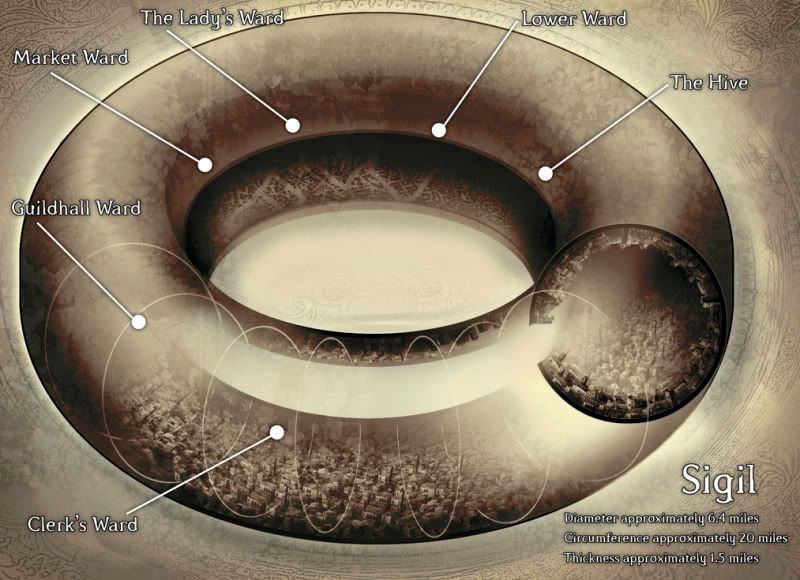
Sigil, the home base for the setting, is a perfect example of introducing "weird" into a game.  Basically the place at the center of the multiverse, with doors to anywhere in the prime material and outer planes, the possibilities within it are potentially endless.  What really strikes me as amazing is the city's layout.  Shaped in the form of a torus like ring, one can literally look up and see the city wrap around with buildings above them.   The city wards themselves change at randomly making it really impossible to fully ever map.  And of course, there are the doors themselves which lead to pretty much any plane of existence one can think of.  Some being hidden, open, locked, etc.  The possibilities for adventure in Sigil alone seem endless.

I'm not sure if I'll ever get to run Carcosa or not, but if it ends up being a "player dump" into that world, I can definitely see them traveling through Sigil.  So, are there any Planescape gamers out there?  Anyone ever used Sigil or any of the other Planescape elements in their campaigns?


Wednesday, January 11, 2012

The Blighted World of Zaoth

One of the projects I'm working on presently is a weird science-fantasy homebrew setting I'm calling the Blighted World of Zaoth.  As such, I've decided to create a separate blog to devote to the development of the world, and use my blog here to focus on my thoughts on DM theory, DnD in general, and what have you.  If you're interested, feel free to hop on over and take a peek.  It's a bit bare at the moment, but content will begin showing up quickly.


The Blighted World of Zaoth - Blog

The Ape-Men of Tharr

Deep within the Forest of Tharr dwell the race of ape-men known as the Kuthar.  They make their abodes high among the tree tops in wooden dwellings linked together by rope bridges.  The ape-men are intelligent, but tribal by nature with a distinct warrior caste system.  Fearless and strong in battle, they fashion their own crude weapons of stone and rock, but have developed the keen ability to utilize firearms, laser rifles, and other weapons and armor they have scavenged over the years from civilizations long forgotten as well.

The ape-men are rarely seen outside the Forest of Tharr, and while their pursuits are not those of conquest and glory outside their realm, they are extremely territorial and approach uninvited trespassers with force.

Rare is it to find an ape-man outside of Tharr, but occasionally a select few will end up wandering amongst the realms of men, often met with a combination of fear and distrust.  In most instances, these Kuthar have been exiled from Tharr and cast out of the tribe, cursed to walk among men.  These displaced ape-men often seek out mercenary work as armed caravan guards or, in the rare instance, as adventurers.

Summary of ape-men abilities and restrictions:

Armor: Any
Weapons: Any
Starting age: 17+1d4
Starting gold: 3d4x10
Classes: Fighter, Cleric
Ability score requirements: 12 STR, 12 CON
Stat modifiers: +2 STR, -2 INT and CHR
Bonuses and abilities: Infravision 30', +1 to hit with spears and any firearms, +3 saving throws vs. poison

Sunday, January 8, 2012

Hexcrawling and Its Fundamental Use in Old School DnD Part 3

Previous entries: Part 1, Part 2.

In the last entry, I discussed creating the first 7 hexes including the starting location (usually a village or city, but could be any civilized area/feature) which is in the center, and at least 3 interesting locations outside of the starting location to explore.

Our starting map with 3 locations to explore

So, this next step requires a little bit of prep time, but don't spend too much time on any of the 3 locations (unless you have the time to do so, that is).  We know we have some sort of tower in hex 04.05, a ruin in 05.03, and a monster lair of some sort in 04.03.  This is the time for some brainstorming.  If you've already taken the time to think of some places/NPCs your PCs are likely to encounter in the starting village (inns, taverns, local lords, sages, etc.) now is the time to start tying them into the surrounding locations.

Why do the NPCs know about the monster lair?  Perhaps it is the home of an ogre who has been pillaging the farms of Windholm at night?  Maybe the spot of a local group of bandits who have been hijacking merchants passing through, effecting the commerce in the village.  Obviously these are quick and simple ideas, but they are presented to give you an example.  Find some way to tie these locations into your starting location.

Jot down some starting notes on each location based on their hex:

04.03 - Lair of Hedgemog the Ogre (stats here in parenthesis)  Has a group of hobgoblins working for him (stats for hobgoblins in parenthesis).  At night Hedgemog wanders countryside (50% chance the PCs might catch him in his lair at night).  During the day he sleeps in his lair and the hobgoblins protect him.

Now, if you have the time, you might want to draw out a quick map of the lair, key it with monsters, traps, etc.  And you'll need to do this for at least the first level of each of the 3 locations, but no more than the first level of each location (if it has multiple levels).  If you're pressed for time, try any number of free dungeon generator tools out there to get a layout for each location quickly, then key it up yourself.

The idea in the sandbox and/or hexcrawl is that the players have freedom of choice to go where they want and basically do what they want (and suffer the consequences therein), so you're going to want to ensure there is incentive for your PCs to want to explore at least one of the areas you've prepared.  There are any number of ways to get your PCs going.  Often most campaigns kick off in the common room of a tavern.  How will the PCs know of these locations or learn of them?  Why should they want to go there?  Perhaps they are approached by an NPC offering payment to retrieve a MacGuffin from one of these locations.  Or perhaps they just hear about one or more of them as prime unexplored locations ripe for plundering via rumors in the town.

Rumors are a great way to get the ball rolling in a sandbox, and in my opinion, offers the PCs the most flexible freedom of choice in what they choose to do.  I would start off with 10-12 rumors with half of them being either completely false or only half-true, while the other half are completely true.  Place them on a chart, and roll for one while they are in the tavern in the first night.  If they actively seek out rumors, roll a die (d4 or d6, subtract reaction adjustment but no less than 0) to determine how many rumors they hear from various occupants of the town.  Roleplaying these out can be great fun as well, and really bring the world alive for the PCs.

The key here is making them WANT to explore places you've prepared.  If you don't make them appealing, chances are your PCs can wander off into areas you haven't really prepped yet, and then you're completely flying by the seat of your pants.  Sometimes this can prove to be just as fun, and to be sure, there will always be a certain level of improvisation that goes into a sandbox or hexcrawl game anyway.

In the next post, I'll discuss topics relating to getting the PCs there (i.e. the actual crawl) from constructing random encounter tables, determining movement, weather, etc.