Pages

Showing posts with label Advanced Dungeons and Dragons. Show all posts

Friday, January 13, 2012

Planescape: Looking Back

I remember when Planescape came out back in 1994, it kind of changed things in D&D.  In some ways this was good, and in others bad.  I recall being a very narrow-minded teen at the time, and my first introduction to anything "Planescape" came in the form of an acquaintance named Joe.  Joe was a power gamer, in the truest sense of the word.  He was min-maxing before there was such a thing.  My group of friends never were really into that aspect of the game.  We always preferred to play characters from the PHB with actual real stats we rolled, with flaws, and who weren't indestructible superheroes.  We liked to focus more on the roleplaying aspect of the game.  As such, we never were big on munchkins entering our sessions.

Enter Joe.  You see, Joe was playing (what else?) a tiefling.  He had been running this tiefling with a few of his friends in the Planescape setting and wanted to enter our campaign.  I had no idea what a tiefling was, and when he told me it was half-demon from the Planescape setting, I immediately put up a mental block for all things involving the setting.  It had, in my opinion at the time, spawned a layer of such cheese that I refused to take it seriously as a campaign world.  Of course, over the years I think the tiefling has developed in the game into something that truly epitomizes what old schoolers hate about the current iterations of the game, going from optional player characters in later editions, to a core race in 4e.

Now, that is not to knock anyone who enjoys playing tieflings.  Truth be told, Joe could have been playing anything and it would have been irritating (especially considering he was toting around a vorpal blade of all things).  My point here being Joe turned me off of the setting years ago because he was a munchkin, and due to my naivety I presumed that if Joe=munchkin playing tiefling from Planescape then Planescape must=cheesy power gamer setting.  Having the chance to look back at it now and review some of the material I've found for it, I hate that I never gave it a shot, because it rocks...a lot.

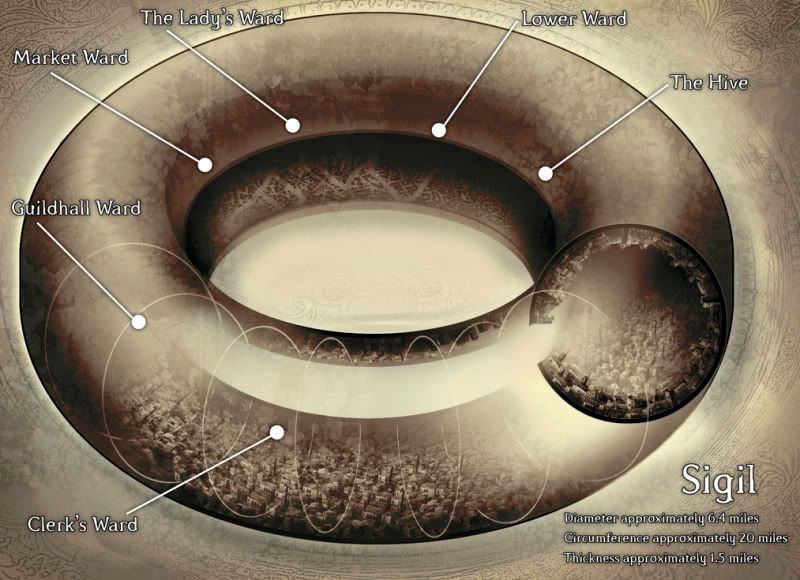
Sigil, the City of Doors


Sigil, the home base for the setting, is a perfect example of introducing "weird" into a game.  Basically the place at the center of the multiverse, with doors to anywhere in the prime material and outer planes, the possibilities within it are potentially endless.  What really strikes me as amazing is the city's layout.  Shaped in the form of a torus like ring, one can literally look up and see the city wrap around with buildings above them.   The city wards themselves change at randomly making it really impossible to fully ever map.  And of course, there are the doors themselves which lead to pretty much any plane of existence one can think of.  Some being hidden, open, locked, etc.  The possibilities for adventure in Sigil alone seem endless.

I'm not sure if I'll ever get to run Carcosa or not, but if it ends up being a "player dump" into that world, I can definitely see them traveling through Sigil.  So, are there any Planescape gamers out there?  Anyone ever used Sigil or any of the other Planescape elements in their campaigns?


Wednesday, December 28, 2011

Hexcrawling and its Fundamental Use in Old School D&D Part 1

The first in a series of posts whereby I discuss the merits of the old school hexcrawl.

In new school era games (3e, 3.5, 4e, etc.) when PCs are expected to travel long distances to get to their next destination, it might be typical for a DM to say "after a week long travel you all arrive at 'destination x,' subtract a week's rations," for the sake of "moving the story along."  That's fine and dandy and all, and maybe the players want that at times, but let's face it, in a world of medieval/weird/apocalyptic fantasy, "getting there" is half the battle.  That's the difference between the old school game and the new school era, video game centric scaled "encounters" in modern RPGs.  In the old school, it's not always about the destination, but more about the journey.  After all, in a fantastic setting peopled with monsters and magic, all kind of things can happen when the PCs are moving through the wilderness, even if they take a populated and well traveled road.

In my present game, it won't be long before the party gets a clue to what will likely be their next destination, should they follow that path of course.  They could certainly choose to ignore it, but most likely they won't.  As such, the journey will take them almost a month, on horseback, even if they take the main road.  In a world of fantasy, a lot can happen in a month's time.  So, in essence, they'll be doing some hexcrawling for a while.  Maybe even a few entire game sessions.  A lot can happen on the way to town.

Hexcrawling has been covered in great detail all over the OSR blogging world.  There is already a wealth of information on the subject.  While some may argue semantics, at its heart hexcrawling is similar to dungeon crawling, except the "crawl" takes place above ground, often in wild, and relative uncivilized lands where lots of interesting things might happen.  It becomes even more dangerous at times than the dungeon crawl, with the probability of getting lost, running out of food, or encountering creatures and people well above the level of the party.

If handled properly, a wilderness hexcrawl can be an exciting and engaging part of your campaign that will be just as enjoyable (maybe even moreso) than the "story" you have presented them with.  So, here is my take on the hexcrawl, some pointers on how to make it engaging, and keep your players' interest in the game.

First, the basic elements of what you need for a hexcrawl are pretty much considered universal.

- A numbered hexmap of the area (preferably with hexes representing 5 or 6 miles...I like to use 6 miles) with various land and terrain features like hills, plains, scrublands, marshes, forests, mountains, radioactive volcanoes, or whatever suits your flavor.

- Populate the hexmap with some interesting locations/events the PCs will discover if they enter the hex.  Basically you're creating a key corresponding to the number of the hex you want the feature to be located in.  Obviously, at first you want to focus on the immediate areas around the hex your party will start from.  There is no need to fully flesh out some ancient ruin 20 hexes away which your PCs might never encounter.  Keep focused on what's immediately ahead of you for the time being, as it will save you hours of unnecessary prep time.  When you're initially doing this, just make small notes about the features, and worry about fleshing out major details, drawing dungeon maps, etc. until later on.  In some cases, you're just going to have to wing it.

- Create random encounter tables.  Depending on the terrain or area, you might roll for an encounter 3 times a day or 6 times.  This is usually up to the DM to determine, although there are guides for such.  The 2e DMG has a table which gives the encounter chance, number of encounters to roll per day and what not based on the terrain type the PCs are passing through.  Random encounter tables can be simple with say only 6 options if triggered, or as complex as 100.  This is up to you.  Obviously the less time you spend on the encounter tables, the less diverse the random encounters will be.

Traveling over long distances for PCs can be tedious.  It's up to the DM to keep things entertaining and engaging for the players.  Random encounters or hex features designed for your party to find should be engaging for some reason.  Perhaps the PCs will discover a village in the next hex they travel to.  But let's say that village is cursed, and its citizens can't leave the village.  The PCs can investigate and maybe find the source of the curse lies in a barrow just outside of town.  Perhaps they'll be led to free the village from the curse at the rumor of some hidden treasure in the barrow.

These types of encounters can lead to little mini-adventures on their own, and can make the hexcrawl something the players will remember and actually WANT to be engaged in.  What you want to avoid is dragging out a pointless journey with uninteresting events i.e. "you travel for half a day, you're attacked by goblins (roll out stupid pointless combat), you take up watch for the night, you encounter some wolves (roll out stupid combat), you wake up and head out again," wash, rinse and repeat...boring.  Make the journey count, and make it interesting.

Tuesday, December 20, 2011

Tavern Game: Rot Grub Roulette

Within the lower quarters of Blackspire it is not uncommon to find patrons of the local taverns engaged in one of the more strange of games, and one of the most dangerous; rot grub roulette.  Two players sit opposite one another, blindfolded, their left forearms exposed, with their right arm tied to the chair behind their backs.  The mediator takes 6 small wooden cylindrical containers and shuffles them back and forth on the table.  Within 5 of the small wooden containers are pairs of harmless maggots.  One of them, however, contains a pair of burrowing rot grubs. 

Each round the two men place bets and the mediator dumps the contents of one container onto one player's forearm.  The player, not knowing if he has been exposed to the rot grub or not, must wait 5 full minutes with onlookers jeering and howling along.  This process is repeated between the players with the stakes getting higher each round as one more wooden container with harmless maggots is taken away making the probability of being exposed to a grub even higher.

No onlooker may attempt to prevent a rot grub from burrowing if exposed, nor douse the player's arm with fire.  If a player manages to free his right arm and do this himself, he is immediately taken outside, beaten and cast aside as a useless craven (if the beating he suffers does not kill him.)  Indeed it is often said that it is better to die from the rot grub than to feel the merciless beating of an angry drunk Blackspire mob.

The game ends when one man decides to quit, losing all his earnings, or one man dies. 

Monday, August 22, 2011

Pitfalls to Avoid in GMing: My Take

Earlier today I posted an entry about pitfalls to avoid when GMing. I noted the common ones known to everyone (fudging dice rolls, railroading, etc.), but I asked others to chime in with their own entries on 3 other common pitfalls to avoid when GMing. So, here is my take on 3 pitfalls to avoid when running a RPG.

1. You didn't make the style of the game clear to the players

You've spent time organizing an adventure, getting the players together, and selecting a nice place to meet up. Only you forgot to mention the theme/style of the game, or even ask the players' input at all. Frequent character death may be a common meme in old school games, but it's not common to everyone who plays RPGs. If your games run a high risk of character death, you need to make this clear up front. Players get annoyed enough when characters die, especially due to bad dice rolls, but it's even more annoying when a player spends several hours working up this amazingly awesome backstory, and fleshing their character out, only to have him/her die against the first batch of giant spiders you throw at the party. Again, frequent character death is almost unheard of in new school RPGs, and if you want to run an old school style game, you need to make it abundantly clear from the beginning. This doesn't just go for frequent character death either. That's just one example. If your game focuses on a mystery the PCs must solve, a combat light horror scenario, or a deathtrap dungeon, you need to at least make some of this known to your players before the game.

2. You plan on using a pet NPC

Avoid this like the plague. There will be moments where you'll think, "hey this is set in that same world I ran my 15th level half-dragon assassin character! Wouldn't it be cool if I introduced him as a NPC in this game?" The simple answer is, no, it wouldn't. Chances are, you'll end up wasting precious time reminiscing about how your uber character knocked off that lich in one round (hyperbole), or managed to con that dragon out of his horde that one time, and frankly, your players don't give a shit. They also don't care to see your pet NPC essentially take over the session doing awesome shit, because you want to show how much of a badass he is. Pet NPCs=bad idea 100% of the time. Don't use them...ever.

3. God, that one character is really annoying. Maybe I should kill him

Let's face it, you're gonna run into that one player whose character is just annoying. You know, the guy whose character has a 3 INT and must always do the absolute dumbest thing in EVERY situation? Or the guy who has acquired that one magical item that he uses as a crutch for perceived invincibility? There's nothing wrong with humbling these characters in games, to be certain, but resist the temptation to simply develop an encounter with the sole purpose of killing the character. It's hard to resist the temptation to simply have the character killed off so the sessions are less annoying, yes, but remember you're the referee and judge, and as such you should always remain fair and impartial. These types of characters will eventually be weeded out by other players if not by simply their own incompetence. I recall years ago, one of our friends was running an extended campaign, and one of our players ran a super annoying red-haired female thief named Mitra. She was always doing things which got us in a jam as a party, and really never showed any true benefit to the group. She was always conspiring behind the party's back, etc. So, what did we do as a group? We sold her character into slavery the first chance we got. The DM didn't have to worry about taking the character out. We did it for him as players. Yes, it resulted in some tense moments between the players, but shit happens. The point is, you as the DM should remain fair, even when one of the player's character is an annoying pissant.

So, these are 3 pitfalls I think are important to avoid in GMing. What are some of your own? Write up your own entries, and comment with the link to your blog here, and I'll compile them in one big post. Again, I'm interested in hearing your own takes on common pitfalls to avoid.

Sunday, July 31, 2011

OD&D and AD&D Fonts

I'm not sure how many of you will find this useful, but I did a search on the old D&D fonts, which led me to a thread on enworld with a link to a now defunct geocities page. Thankfully with the help of the way back machine, I was able to view an archived version of the page from 2009, which lists most of the fonts TSR used for OD&D and AD&D and most of their products associated with the brand. I used screengrab to snap up a pic of it, which you can find below. Some of this may be common knowledge, but there's a lot of other useful info there as well, and many variations of these fonts can be found on the web for free (i.e. Quentin Caps on http://dafont.com)

**edit** Thanks to Ohio Metal Militia, this page now has a new home. http://www.hahnlibrary.net/rpgs/tsrfonts.html

Here's the snapshot.

Saturday, July 30, 2011

My Great AD&D Amazon Score

The other day I decided to order a 1e AD&D DMG from Amazon.  I mainly wanted a cheap used copy to use as a game aid at the table for our D&D sessions.  The seller was letting it go for around $6 and according to the description from the seller: "a little shelf wear, binding intact, good usable copy."  So I ordered it and it arrived today in the mail, and after opening up the package, I was almost struck unconscious by the condition of this magnificent tome.  The binding was in perfect condition, there was some minor shelf wear on the corners, and the pages were even white with no yellowing!  No drawings or pen marks, no missing pages, and completely intact.  These pictures really don't do it justice, but here they are anyway.

 
Click to enlarge.  Cover is in remarkable condition.
As you can see above, the cover is in unbelievable condition.  Hard to tell there, but it even still has a little shine to it.

The binding is in near perfect condition.
Just as the seller said the binding is indeed intact, but I was shocked at just how "intact" it was.  No tears, or rips at all.

Pages are white and all there. No markings inside.
I'm not really sure if the pic above can do it justice, but the pages are crisp and white, and not yellowed with age at all nor brittle.  They're all there with no markings or writings.  They look brand new in fact.

Clean back cover with no scratches or scuffs.
The back cover has no scratches or scuffs, and much like the front cover, still has a little shine on it.

To say I was shocked at this find is an understatement.  I'm honestly not certain how they were able to maintain this book in this condition without realizing the value of it.  A copy like this could easily sell for $40-$50 on ebay or some other site.  I was expecting something heavily used and worn out, which was fine, because I was planning on using it at the table myself, as I said above.  Instead, I'm thinking of holding this one back and not using it at all.  It's rare to find a copy of this book in this good a shape and not pay an arm and a leg for it.  I'm very pleased.

Saturday, July 16, 2011

Making Zero Level Villains that Can Terrorize the Party

I posted a campaign summary of the first session of my Cormyr campaign a week ago or so. If you read that post, you are probably already somewhat familiar with Lasander Highmoon, the NPC that hired the party to retrieve his supposed "stolen merchant wares" from the Rogues of Tilverton. Highmoon introduced himself to the party as a merchant from Arabel and proprietor of the Red Sun Trading Coster.

Some simple investigating from the party would have revealed much about Highmoon, had they not been so impulsive (or greedy.) For one, Highmoon seemed to know a lot about Tilverton, and more importantly the thieves guild therein. He knew a lot about the intricate sewer network the rogues use to smuggle goods, the black market in the sewers, and he even knew where his goods were being kept and the main access points to get into the place. In other words, he knew a hell of a lot more about this city than any simple merchant from another city should know.

The PC's never bothered to talk to any other locals about Highmoon. They never asked any questions of the man. Some of the locals likely would have pointed out that Highmoon is, in fact, a local of Tilverton. They also never checked into this supposed merchant company he owns. A quick public record search would have revealed there is no merchant company called "Red Sun Trading Coster" in Cormyr.

The PC's were rather curious at the large sum of money they were to receive for retrieving the goods (1,000 gp), but their lust for money overcame their sense of curiosity, and thus they attempted to raid the warehouse that very night, which was a botched effort entirely.

So, who is Lasander Highmoon really? He is a pawn himself, but a smart one. He serves a death cult devoted to the dead god Myrkul, who operates out of the sealed off crypts underneath the city of Tilverton. What exactly is in those crates that were stolen? A piece of an ancient evil artifact called the Crown of Horns, which contains the essence of Myrkul within. I'll go into more detail about this item in a later post.

Highmoon is a zero level NPC, and one whom will likely be a focus of the party's attention when they finally figure out what he's up to (if they do find out anyway.)
As I know they'll meta-game the hell out of this guy once they figure some things out, I imagine they'll likely be terrified to confront him for fear that he is some evil high level cleric capable of obliterating them at lower levels. He, of course, could do no such thing, and were the party to search him out and manage to confront him, they'd slay him rather easily, but they won't do that...not for a while at least because they will dwell in terror of this NPC.

A zero level NPC, with the proper backing and means, can become a true horror in the eyes of your players, and especially when they don't know that he's just a common man. Villains in the campaign are supposed to be crafty and cunning, and they don't have to be of a high level to terrorize your party. With the proper motivation and means, even a common man can be a threat to a group of adventurers.

Wednesday, July 13, 2011

Updated More User Friendly Dreadrock Dungon Level 1-1 PDF

It came to my attention, that the version of level 1-1 of Dreadrock wasn't exactly user friendly. I went in and adjusted the image, along with the room numbers on the map (as my hand writing scanned in is difficult to read). I also added some notes about the dungeon as well. I think you'll find this version MUCH easier to read, print, and work with in your game. Lesson learned.

Updated download for Dreadrock Dungeon Level 1-1 PDF

Tuesday, July 12, 2011

Got my d30; Also a Random d30 Dungeon Oddity Table


A while back I ordered a first edition MERP boxed set, as I always wanted to play/run it, but never had the opportunity back in the day. After thumbing through the rules again for the first time in many years, I noticed that the game itself calls for a set of twenty-sided d10's. Most of you old schoolers out there are likely familiar with these dice, but I have not seen one anywhere in a number of years. The boxed set I bought second-hand came with 2 standard d20s. I presume the previous owner did not understand the games' use of the proper twenty-sided d10's and just threw in some old d20's he had laying around. An easy mistake to make. And yes, I know that MERP could easily be played by substituting other dice in lieu of the twenty-sided d10's, but call me anal. I wanted the dice the game was supposed to use.

In searching for some twenty-sided d10's I stumbled upon a site familiar to most I'm sure; http://www.gmdice.com/. They had the twenty-sided d10's available for a very low price (something like 25 cents, or maybe 50 cents each). Well, I thought this would be just as good a time as any to throw in some d30's into the order as well, since they had them available for only $1.50 each. I couldn't tell whether I was more excited to finally get myself a d30 or to get the twenty-siders I wanted!

My dice finally arrived in the mail yesterday, and I thought it would only be appropriate to make up a d30 table to celebrate the occasion.

Some folks say that the measure of "evilness" of a DM is how many save vs deaths his player has to make in a campaign, but I disagree. To me, there is nothing more thrilling than throwing out red herrings into a campaign and watching the PC's go crazy over nothing. That's where my table comes in. These are 29 random oddities that may appear in a dungeon, but have little to no impact on the PC's. Of course, you could easily use some of these to spark an adventure hook and make them actually mean something in the dungeon crawl, but if not, just roll occasionally on the table, and watch the players go nuts.

Another thought I had in making the table is the fact that often we know as DM's that dungeons are looted, restocked, looted again, and the process repeats itself, not only by the party in the campaign, but likely by many other adventurers over the years. In many entries in the table, you'll find the results of previous adventuring experiences by other adventuring parties along the way. Some examples include the soot covered hallway, which is the result of a fireball spell from a mage, or the hand hanging out of the wall as a result of a bad teleport attempt. I think these sort of oddities bring a dungeon crawl to life. So, enough rambling by me. Check out the table and enjoy.

d30 Random Dungeon Oddities Table

01. A sudden gust of wind whisks through the hall/room with a noticeablely foul odor
02. A ghostly image of a beautiful maiden passes through the walls and disappears
03. A loud, mad cackling echoes through the hall/room.
04. All torches the party are carrying flicker in and out like a strobe light for 10 seconds
05. Faint whispers echo through the hall/room
06. Shadows of 4 large humanoids appear on the walls approaching the party, but there is nothing there
07. Screams of a young woman can be heard echoing through the dungeon
08. A blue glowing orb appears in front of the party illuminating the hall/room then disappears
09. Small obsidian statue of creature with tentacled head and wings perched on a globe lies on the floor
10. The skeletal remains of an adventurer clinging to a necklace and a note which reads "For Aveyah"
11. Cultish symbol drawn in blood on the wall
12. Ritual dagger on the ground with fresh blood which never seems to dry. Even after the blood is wiped off it will reappear in minutes still wet
13. Uncovered pit trap with the remains of two adventurers imapled on its spikes
14. A group of giant rats scurries in front of the party with one carrying a gold bracelet around its neck
15. A strange fungus growing on the wall. When a PC walks near it one of its spores explodes creating a yellow gas cloud 3x3 feet. Save vs Poison or laugh hysterically for 1d6 rounds
16. A broken torture rack covered in cobwebs with the remains of a humanoid attached
17. A loose flagstone in the floor of which underneath is a small hole containing a music box
18. A messaged carved into the wall which says "Beware he who cannot be seen"
19. The remains of several giant rats scattered about all with their heads removed
20. A decayed human arm sticking out of a wall, the result of a botched teleport spell
21. A goblet with a clear liquid within resting on a table. If the liquid is consumed it makes the PC queasy, but nothing more
22. The skeletal remains of an adventurer impaled against the wall by a spear
23. The sound of a group chanting in an ancient indiscernible language echoes through the halls
24. A basilisk that has been turned to stone, probably from a reflection of his own gaze
25. Soot covers the walls, ceiling, and floor, along with the ashen remains of some humanoids
26. An open wooden chest with a leather-bound tome. If the tome is taken it will vanish and reappear in the chest
27. A broken, blood-stained altar now covered with the holy symbol of a good aligned god
28. A green slime consuming several giant rats. The slime can be easily maneuvered around by the PC's
29. One of the PC's hears a click sound as he steps on a loose flagstone, but nothing happens
30. Reroll twice and combine results

Dreadrock Dungeon Level 1-1 Download

As promised, here is the first PDF download for Dreadrock Dungeon Level 1-1. This is the first of four planned quadrants that make up the whole of level 1 of the megadungeon. Included in this is a small preview map for easy cross referencing, a dungeon key with all 45 rooms keyed, a wandering monster table, restock table, trap legend, and a high resolution map for printing.

In the future I plan on releasing a full PDF collection on the dungeon, its inhabitants, and some background on the dungeon itself, some of which I've already posted here on the blog. I hope you enjoy the first taste of Dreadrock.

Dreadrock Dungeon Level 1-1 PDF Download

Friday, July 8, 2011

Dreadrock Dungeon: The Rakshir Orcs

The Rakshir Orc tribe first appeared in the halls of Dreadrock some ten years ago.  They migrated from the deeper levels connecting into the vast of the underdark and slowly made their way to the oldtown area (located in level 1-1 of the dungeon) of the ruins.  The oldtown area was once home to the common dwarven citizens of Karzamir before the fall of the civilization.  Presently, the Rakshirs have managed to fortify this area of oldtown, and it has become their permanent tribal home.  The area is heavily fortified with armed orc soldiers and crude traps constructed throughout the dungeon.  The tribe itself consists of approximately 100-120 orcs, mostly males.  Their chieftain is an Orc named Ghorash who has a guard of 10 orc warriors and at least 1 orc shaman with him at all times.  The Rakshir orcs remain in a constant struggle with the Warghash Goblin tribe, and the two sides are often battling over supplies and control of their areas.  The two sides constantly raid the others's areas scavenging and stealing supplies.  In addition to the Warghash, the Rakshir are constantly working to stave off curious adventurers who frequently make their way into the dungeon, which has proven to be a drastically difficult task.  Recently the humans in Dreadrock Bluff sealed off the main entrance from the mountain in order to secure a more stable entrance they can control (via a dimension door) which is situated near their tribal holdings in the dungeon.
 
The Rakshirs have managed to accumulate a small amount of slaves (mostly kobolds, but some humans as well).  The Rakshirs use these slaves primarily to work on digging out a tunnel which will lead to the surface, allowing them to make raids into Dreadrock Bluff, and the merchants and travelers coming into the town.  The people of Dreadrock Bluff are currently unaware of this activity. 
 
The members of the Rakshir tribe have an interesting method of disposing of captured enemies and prisoners.  Located in a sub-level near their tribal quarters, is a small cavern.  Orcs will often deliver enemies, goblins, kobold slaves, and captured adventurers to this cavern where they must face the wrath of the creature they call Stone-eye.  Stone-eye is a basilisk, and the orcs manage to keep him contained by offering him the carcasses of their enemies to feast upon, as well as the remains of their own dead.  This tactic has worked thus far in keeping Stone-eye in his own lair.
 
 
GM Notes: If any PC's encounter kobolds in the dungeons, they will always be with at least 1 orc warrior (the slave master), and the kobolds will always be unarmed.  If any PC's manage to communicate with kobold slaves, they will offer to help the PC's clear out the orc tribe if they promise them their freedom afterwards.  The PC's would have to raid the orc weapon cache in the dungeon, or find some way to arm the kobolds, before they will agree to fight with the party. 

Thursday, July 7, 2011

Dreadrock Dungeon: An Introduction

Dreadrock Dungeon is a massive labyrinth of tunnels with various levels situated under, what has come to be called, Dreadrock Mountain.  The dungeon was first discovered merely 3 decades ago by chance by a party of adventurers who were fleeing a band of mercenaries in the valley.  They stumbled upon the sealed entrance, and seeking to flee and hide from their pursuers, they managed to open the passage into, what they would soon discover to be the ruins of an ancient dwarven civilization.  A millenia ago, the dwarven city of Karzamir was one of the largest dwarven civilazations in the realm.  For reasons still undetermined, the city was virtually wiped out, and the tunnels leading into the city were sealed shut.  Eventually as time passed, Karzamir was forgotten and knowledge of its existence faded in the realms.  A few historians and sages knew of the place, but after centuries it became nothing more than a place of myth and legend.
 
After the discovery of the dungeon by The Company of the Black Rose, who spent quite a few years exploring its depths and exploiting the hidden riches within, word began to spread about the newly found ruins.  People of all races, especially dwarves, came to the mountain looking for opportunities of their own.  Eventually the members of The Company of the Black Rose retired from adventuring, now rich beyond measure.  A few went back to their own homelands, while a few stayed behind, erecting a small settlement near the entrance to the dungeon.  Soon, others followed suit settling in the town now known as Dreadrock Bluff, situated along the side of the mountain.  Dreadrock Bluff is now a small town with approximately 10,000 citizens, most of which make their living by catering to the adventurers who flock to explore the riches of Dreadrock.  There are various inns and taverns in the town, most charge exorbitant prices in comparison to other towns, because of the convenience of location to the dungeon.  Various sundry shops, weapon and armor shops, smiths, sages, and temples can be found within Dreadrock Bluff's walls, all willing to help the curious adventurer, for a price of course.
 
Dreadrock Dungeon is not without its dangers of course, and many adventurers who decide to explore its depths never return.  The locals in the area simply call it "The Rock."
 
Note: Dreadrock Dungeon is a site based dungeon which can easily be incorporated into any campaign setting or world.

Wednesday, July 6, 2011

New Project: Megadungeon - Dreadrock Dungeon

"Woe to ye who delve into the halls of that forsaken place. Abandon your Gods for even they dare not enter The Rock"

I'm officially announcing my new project here; Dreadrock Dungeon. So what exactly will this entail? A large scale megadungeon spanning at least 3 levels which will keep those greedy players of yours adventuring for months and months.

I'm planning on releasing the megadungeons here on the blog divided into quadrants in PDF form complete with room and area descriptions, random encounter tables, treasure, and of course the ever important monsters, tricks, and traps, along with a brief synopsis on each area, its denizens, and possible adventure hooks. Once the project is complete, which I don't anticipate for quite a while, I would like to collect them all together into one POD book possibly through Lulu.

Over the next few weeks I'll be posting entries here and there with tidbits on the design process, the various factions within the dungeon, etc. I have already mapped out the first quadrant, and plan on keying it up and putting it in an easy to review PDF within the next week or so.

This megadungeon will be compatible with most older editions of AD&D, as well as OSRIC and will be released under the terms of the OGL.

Cormyr Campaign: Session 1

As I have mentioned in previous posts, this past Friday I finally got the chance to sit around the table to play some AD&D with my old gaming buddies for the first time in many years.  We ran 2e, but more or less I run a hybrid of 1e and 2e.  The campaign is set in the Forgotten Realms in the northeastern part of Cormyr in a city called Tilverton.  I chose this spot because it sits along the border of the kingdom and for all intents and purposes is still very much a frontier town in an otherwise stable kingdom.
 
Some Realms purists may note I took a bit of liberty with the NPCs and factions here in order to make things more intriguing for my players.  For example, Tilverton is the only major city in Cormyr with a thieve's guild inside its walls.  The Purple Dragons have a garrison 850 men strong (considerably high for most cities and towns in the kingdom) in order to quell raids by the "border raiders" in the Stonelands region adjacent to the city.  The Stonelands themselves are an area rife with goblins, orcs, ogres, and brigands, not to mention the Zhentarim, so a strong military presence is required in order to keep the peace in the region.  As such, the posting here by a Purple Dragon soldier is a very dangerous one compared to most other postings in the kingdom.  So, I decided to add a bit of a twist here with many of the Purple Dragon soldiers, including the garrison commander, being "on the take" from the thieve's guild, aka the Rogues of Tilverton.  The Rogues provide the soldiers with a little extra money on the side to turn a blind eye to their underground actvities, of which there are many.  The logic behind this being, due to the danger of the posting at this garrison, many of the soldiers feel they deserve a little something "extra" to compensate for putting their necks on the line in a region filled with danger and strife.  Of course, when the game begins, the players don't know this.
 
Cast of characters:
 
Sir Bryndan Lowman of White Forks - Human, Fighter, 1st level.  A hedge knight from the nation of Cormyr.  His family squandered away all of his lands and holdings so all he has left is his title.
Kylar - Elf, Ranger, 1st level
Clangar - Dwarf, Fighter/Cleric, 1st level
Maverick - Half-elf, Thief, 1st level
Solaris - Elf, Thief/Mage, 1st level
Myst - Human female, Mage, 1st level
Sylana - Human, female, Bard, 1st level
 
 
Session 1 Summary:
 
The PC's enter the city, and are directed by the Purple Dragon soldiers at the gate that the best inn in town is Grimwald's Revenge in the oldtown section.  The PC's one by one made their way to the inn.  The patrons in the inn don't look to be travelers at all, and seem to be a bit on the shady side.  They PC's pay for their rooms and sit down to enjoy some dinner when one of the men in the inn approaches them each individually asking them if they want to play in a card game with he and two of his friends.  Solaris, Kylar, and Sylana accepted the offer to play, while the others chose not to.  The other PC's who did not play in the card game, received some free ale courtesy of a strange man in the corner of the inn.  The PC's who were not playing, go over to talk to the gentleman kind enough to buy them a drink. 
 
During the game, Sylana, the bard, attempted to cheat using a sleight of hand cantrip, and was caught, which caused quite a ruckus.  The local and his two friends stood up, along with just about everyone else in the inn, expecting a fight.  They put their hands to their daggers, but the bard, who did not win the game despite cheating, managed to talk her way out of a fight.  After the game, each of the party members ended up sitting together with the strange man in the corner of the inn.
 
The man introduced himself as Lasander Highmoon of Arabel, and owner of the Red Sun Trading Coster.  He tells the party that Grimwald's Revenge is not safe, and that they should seek out another inn in town called the Whispering Witch.  He agrees to meet them there after one hour.  One by one, the PCs slowly filter out of Grimwald's met with stares by the locals in the inn.  After a while, they all meet up at the Whispering Witch where Highmoon tells them Grimwald's Revenge is actually a front, and is in truth the headquarters of the Rogues of Tilverton.  The Rogues pay the Purple Dragons working the gates to send any adventurers and mercenaries they see entering the town to the inn.  This allows the Rogues to measure up any threats, and deal with them if need be.
 
Highmoon goes on to tell the party that he was on a journey from Arabel to the Moonseas with his wares when he was met upon the road by brigands who stole his goods.  These brigands were actually members of the Rogues, he later found out, and after some information gathering, he was able to determine that the Rogues had his wares in an abandoned warehouse in the city.  He is willing to pay the party 1,000 gold pieces (Gold Lions) to retrieve his wares from the warehouse.
 
The party, seeing an opportunity to make a good amount of coin, agree to the mission.  Highmoon takes them into the city and shows them the warehouse, which appears to be completely abandoned and boarded up from the outside.  Some of the party members pay attention to the area trying to spot guards or spotters for the Rogues, of which they find none.  Highmoon tells the party there are three ways into the building; the front door, a sewer access route which the Rogues use to transport their stolen goods and sell them in the sewers in the black market, and a small access door on the roof of the structure.
 
After discreetly casing the warehouse, they all go back to the Whispering Witch Inn to formulate a plan.  Solaris, however, stays behind to further case out and investigate the warehouse.  After deciding on a plan (or not deciding as it were), the party came back to the warehouse.  At this point, Maverick, using his infravision, was able to spot a figure on top of the warehouse, but could not make out any details.  This figure was Solaris, who was now on the roof.  Solaris dropped a rope down the side of the warehouse in an alley so the party could ascend to the roof.  Maverick sees the rope, but no one else in the party was able to notice.  Maverick decided not to pass this information onto the party.  Instead, they go to the front door of the warehouse, and attempt to listen in.  They hear nothing, and after a few moments, Maverick rattles the doors gently and whispers.  He does this several times, until finally he hears footsteps inside the warehouse approaching the door.
 
Kylar, standing back with his bow ready, notices a small slot open in the window adjacent to the door, and after a few seconds it closes again.  In the meantime, Solaris, thinking the rest of the party is coming up the rope to back him up, decides to open the access door on the roof.  In doing so, he is unable to avoid the door squeaking, and he opens it to find 5 men sitting around a table in a room below.  Hearing the door open they look up, but are caught off guard.  Solaris casts a sleep spell knocking out 4 of them.  The other, a mage, attempts to cast a sleep spell on Solaris, not realizing he is an elf.  Solaris resists the sleep spell and tumbles into the room.  The mage wins the initiative, and attempts to cast a spook spell on Solaris, which again fails.  Solaris misses his attacks the next round, and the mage turns to run away.  He manages to get away, and Solaris slits the throats of the other 4 men in the room.
 
Meanwhile, down at the front door, Clangar and Bryndan decide to bash the hinges off the door.  Clangar was successful in doing this, bringing the door halfway from the door frame.  He ripped the rest of the door down, and the group entered a long horizontal hallway.  Back inside the warehouse, Solaris is finishing off the last of the 4 he put to sleep when the mage returns, this time with 2 of his friends armed with crossbows.  Solaris attempts an escape up the ladder to the access door, but the men fire shots from their crossbows.  The bolts are laced with poison, and Solaris fails his saving throw, and falls unconscious.
 
After ripping to door down at the front of the warehouse, the rest of the party suddenly hears a bell ringing within the warehouse, and decide to retreat back to the inn.  They arrive back at the inn to find Highmoon, stunned to see them back so soon, and of course, without his wares in tow.  He tells the party that the Rogues will most certainly be moving the stolen goods in the warehouse through the sewers and into the black market after this botched attempt to raid the place.  The party, fearing to traverse the complex network of tunnels in the sewers instead learn from Highmoon that there is an access tunnel from the Stonelands that leads into the sewers underneath the city.  This tunnel is used to transport stolen goods from the black market by the goblins and border raiders in the Stonelands.  Not knowing where this tunnel is, the party decides to go into the Stonelands to find the tunnel and attempt to take back the wares.
 
Meanwhile, after a bit, Solaris wakes up to find himself bound in a chair with 3 men in the room, one standing directly behind him.  One of the men, apparently senior to the other 2, begins to interrogate Solaris.  Solaris attempts to convince them that he was working alone, and was trying to display his worth in an attempt to join the guild, to which the interrogator scoffs.  He knocks Solaris back out and orders him thrown into a cell.
 
Highmoon sneaks the rest of the party out of the city in the back of a cart, and tells them he will meet them in a small village south of Tilverton in one week.  If they fail to bring the wares in one week, the deal is off, and he will have to move on to other options.  That night, the party entered the Stonelands and set up camp.  The next day after essentially walking aimlessly in the Stonelands for half a day, Kylar scouts ahead and discovers a trail with recent wagon tracks leading west away from the direction of the city.  The party decides to follow this trail for a while with Kylar scouting ahead.  After some time, Kylar discovers a goblin ambush party situated near the road ahead and reports this back to the party.  The party engages the band of 6 goblins and defeats them.  Myst managed to put 3 of the goblins to sleep with a color spray spell, and after the battle, Maverick slits the throats of the 3 remaining goblins.  It was here that we ended our first session.
 
Reflections on the first session:
 
I noticed several things the party did wrong, specifically Maverick, which did not make sense to me.  Upon the initial raid on the warehouse, he saw the rope come down, and chose not to investigate or even tell anyone else in the party.  He was simply metagaming because he knew out of character that it was Solaris that dropped the rope.  Why he chose to ignore this, is beyond me.  The next gaffe came on the goblin ambush in the Stonelands, which was really nothing more than a random encounter.  The party knew that goblins used the tunnel access point to get into the sewers, but they had no idea where the tunnel was or how to find it.  One would think it a good idea to capture and question one of the goblins they had managed to put to sleep.  Instead, Maverick chose to slit their throats.  So, now when we pick back up, they will still be roaming around in the Stonelands, which are vast, looking for a tunnel in which they haven't the slightest clue where it might be and is likely hidden from plain view anyway.
 
It was an odd session to say the least.  I was expecting an extreme manner of caution when approaching the warehouse and they all were fairly careful in how they approached the situation.  I touched upon this in my previous post, Why Not 4th Edition, but a major difference in that game and old school DnD is game balance.  In 4th edition, the players know that whatever challenge they face, they have an opportunity to defeat the enemy, succeed in their skill challenges, and effectively "win" the scenario.  In old school DnD, that is not always the case, and most of my players know this because most of them (with the exception of Maverick, Myst, and Solaris) have been playing old school DnD for years.  In old school DnD, you can't simply bust in the front door and expect to win every fight, because you never know what's on the other side of that door.  After breaking the door down, and hearing the warning bells, one of the veteran players immediately yelled out to run.  Knowing when to run is just as important as knowing when to fight in old school DnD.  After the botched raid, they were all commenting on how epic of a fail it was, while I simply reassured them, no, you're still alive.
 
It was still a lot of fun to sit around the table again. The players were really into it, although they obviously had some tactical issues with raiding the warehouse. Most of all I noticed no one really seemed to want to take charge, and make a decision the party could agree with. Still yet, we are planning on playing again next month, so I look forward to playing and updating on their antics.