Pages

Friday, January 13, 2012

Planescape: Looking Back

I remember when Planescape came out back in 1994, it kind of changed things in D&D.  In some ways this was good, and in others bad.  I recall being a very narrow-minded teen at the time, and my first introduction to anything "Planescape" came in the form of an acquaintance named Joe.  Joe was a power gamer, in the truest sense of the word.  He was min-maxing before there was such a thing.  My group of friends never were really into that aspect of the game.  We always preferred to play characters from the PHB with actual real stats we rolled, with flaws, and who weren't indestructible superheroes.  We liked to focus more on the roleplaying aspect of the game.  As such, we never were big on munchkins entering our sessions.

Enter Joe.  You see, Joe was playing (what else?) a tiefling.  He had been running this tiefling with a few of his friends in the Planescape setting and wanted to enter our campaign.  I had no idea what a tiefling was, and when he told me it was half-demon from the Planescape setting, I immediately put up a mental block for all things involving the setting.  It had, in my opinion at the time, spawned a layer of such cheese that I refused to take it seriously as a campaign world.  Of course, over the years I think the tiefling has developed in the game into something that truly epitomizes what old schoolers hate about the current iterations of the game, going from optional player characters in later editions, to a core race in 4e.

Now, that is not to knock anyone who enjoys playing tieflings.  Truth be told, Joe could have been playing anything and it would have been irritating (especially considering he was toting around a vorpal blade of all things).  My point here being Joe turned me off of the setting years ago because he was a munchkin, and due to my naivety I presumed that if Joe=munchkin playing tiefling from Planescape then Planescape must=cheesy power gamer setting.  Having the chance to look back at it now and review some of the material I've found for it, I hate that I never gave it a shot, because it rocks...a lot.

Sigil, the City of Doors


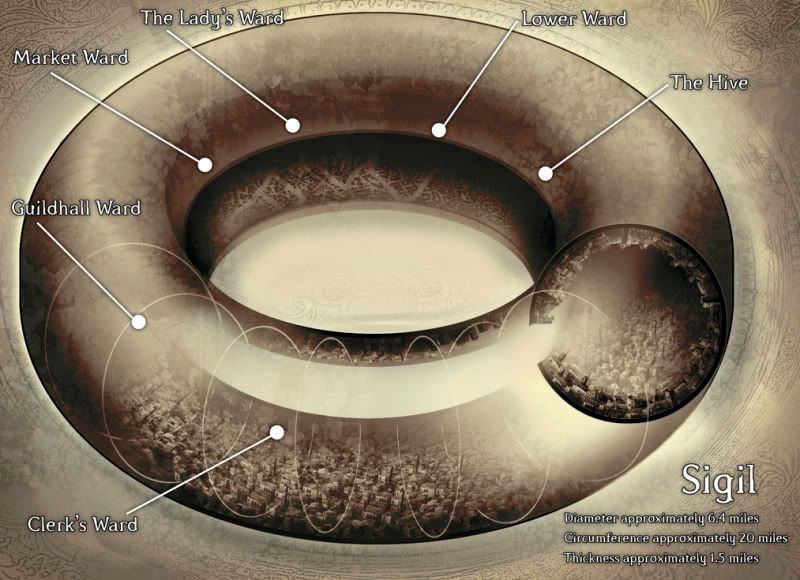
Sigil, the home base for the setting, is a perfect example of introducing "weird" into a game.  Basically the place at the center of the multiverse, with doors to anywhere in the prime material and outer planes, the possibilities within it are potentially endless.  What really strikes me as amazing is the city's layout.  Shaped in the form of a torus like ring, one can literally look up and see the city wrap around with buildings above them.   The city wards themselves change at randomly making it really impossible to fully ever map.  And of course, there are the doors themselves which lead to pretty much any plane of existence one can think of.  Some being hidden, open, locked, etc.  The possibilities for adventure in Sigil alone seem endless.

I'm not sure if I'll ever get to run Carcosa or not, but if it ends up being a "player dump" into that world, I can definitely see them traveling through Sigil.  So, are there any Planescape gamers out there?  Anyone ever used Sigil or any of the other Planescape elements in their campaigns?


Wednesday, January 11, 2012

The Blighted World of Zaoth

One of the projects I'm working on presently is a weird science-fantasy homebrew setting I'm calling the Blighted World of Zaoth.  As such, I've decided to create a separate blog to devote to the development of the world, and use my blog here to focus on my thoughts on DM theory, DnD in general, and what have you.  If you're interested, feel free to hop on over and take a peek.  It's a bit bare at the moment, but content will begin showing up quickly.


The Blighted World of Zaoth - Blog

The Ape-Men of Tharr

Deep within the Forest of Tharr dwell the race of ape-men known as the Kuthar.  They make their abodes high among the tree tops in wooden dwellings linked together by rope bridges.  The ape-men are intelligent, but tribal by nature with a distinct warrior caste system.  Fearless and strong in battle, they fashion their own crude weapons of stone and rock, but have developed the keen ability to utilize firearms, laser rifles, and other weapons and armor they have scavenged over the years from civilizations long forgotten as well.

The ape-men are rarely seen outside the Forest of Tharr, and while their pursuits are not those of conquest and glory outside their realm, they are extremely territorial and approach uninvited trespassers with force.

Rare is it to find an ape-man outside of Tharr, but occasionally a select few will end up wandering amongst the realms of men, often met with a combination of fear and distrust.  In most instances, these Kuthar have been exiled from Tharr and cast out of the tribe, cursed to walk among men.  These displaced ape-men often seek out mercenary work as armed caravan guards or, in the rare instance, as adventurers.

Summary of ape-men abilities and restrictions:

Armor: Any
Weapons: Any
Starting age: 17+1d4
Starting gold: 3d4x10
Classes: Fighter, Cleric
Ability score requirements: 12 STR, 12 CON
Stat modifiers: +2 STR, -2 INT and CHR
Bonuses and abilities: Infravision 30', +1 to hit with spears and any firearms, +3 saving throws vs. poison

Sunday, January 8, 2012

Hexcrawling and Its Fundamental Use in Old School DnD Part 3

Previous entries: Part 1, Part 2.

In the last entry, I discussed creating the first 7 hexes including the starting location (usually a village or city, but could be any civilized area/feature) which is in the center, and at least 3 interesting locations outside of the starting location to explore.

Our starting map with 3 locations to explore

So, this next step requires a little bit of prep time, but don't spend too much time on any of the 3 locations (unless you have the time to do so, that is).  We know we have some sort of tower in hex 04.05, a ruin in 05.03, and a monster lair of some sort in 04.03.  This is the time for some brainstorming.  If you've already taken the time to think of some places/NPCs your PCs are likely to encounter in the starting village (inns, taverns, local lords, sages, etc.) now is the time to start tying them into the surrounding locations.

Why do the NPCs know about the monster lair?  Perhaps it is the home of an ogre who has been pillaging the farms of Windholm at night?  Maybe the spot of a local group of bandits who have been hijacking merchants passing through, effecting the commerce in the village.  Obviously these are quick and simple ideas, but they are presented to give you an example.  Find some way to tie these locations into your starting location.

Jot down some starting notes on each location based on their hex:

04.03 - Lair of Hedgemog the Ogre (stats here in parenthesis)  Has a group of hobgoblins working for him (stats for hobgoblins in parenthesis).  At night Hedgemog wanders countryside (50% chance the PCs might catch him in his lair at night).  During the day he sleeps in his lair and the hobgoblins protect him.

Now, if you have the time, you might want to draw out a quick map of the lair, key it with monsters, traps, etc.  And you'll need to do this for at least the first level of each of the 3 locations, but no more than the first level of each location (if it has multiple levels).  If you're pressed for time, try any number of free dungeon generator tools out there to get a layout for each location quickly, then key it up yourself.

The idea in the sandbox and/or hexcrawl is that the players have freedom of choice to go where they want and basically do what they want (and suffer the consequences therein), so you're going to want to ensure there is incentive for your PCs to want to explore at least one of the areas you've prepared.  There are any number of ways to get your PCs going.  Often most campaigns kick off in the common room of a tavern.  How will the PCs know of these locations or learn of them?  Why should they want to go there?  Perhaps they are approached by an NPC offering payment to retrieve a MacGuffin from one of these locations.  Or perhaps they just hear about one or more of them as prime unexplored locations ripe for plundering via rumors in the town.

Rumors are a great way to get the ball rolling in a sandbox, and in my opinion, offers the PCs the most flexible freedom of choice in what they choose to do.  I would start off with 10-12 rumors with half of them being either completely false or only half-true, while the other half are completely true.  Place them on a chart, and roll for one while they are in the tavern in the first night.  If they actively seek out rumors, roll a die (d4 or d6, subtract reaction adjustment but no less than 0) to determine how many rumors they hear from various occupants of the town.  Roleplaying these out can be great fun as well, and really bring the world alive for the PCs.

The key here is making them WANT to explore places you've prepared.  If you don't make them appealing, chances are your PCs can wander off into areas you haven't really prepped yet, and then you're completely flying by the seat of your pants.  Sometimes this can prove to be just as fun, and to be sure, there will always be a certain level of improvisation that goes into a sandbox or hexcrawl game anyway.

In the next post, I'll discuss topics relating to getting the PCs there (i.e. the actual crawl) from constructing random encounter tables, determining movement, weather, etc.

Thursday, January 5, 2012

It's a Game, Not a Novel Played Out With Dice

Alexis has a great post up today about player agency, using NPCs based on behavior and motivations, and how that can, and should, define the "narrative" within a DnD game.  I'm not going to attempt to personally attack Alexis here, so I hope it's not perceived as such, but he is a rather controversial figure here in our little blogging world.  Most of his posts, despite what can be looked at as written with a somewhat pretentious attitude, are interesting, informative and entertaining to read.  Despite his somewhat contemptuous and misanthropic demeanor in our little corner of the world, he quite often has these moments of genius which make you look back and say "fuck yeah!" and this is one such moment.
 
There is often this perception that the "sandbox" cannot co-exist with the "story narrative" in DnD.  I believe, however, that the two are so intertwined that neither element can be successful without the compliment of the other one.  The modern day RPG focuses on "paths" and "storylines" in which there are defined encounters or events that are going to happen no matter what the PCs do.  These narrative railroads essentially lead the PCs down a trail where the DM is the storyteller, and the players little more than kids sitting around the campfire, listening, and maybe rolling some dice here and there. 
 
In the sandbox, however, there are an infinite amount of storylines happening all over the place.  The ones the PCs choose to get involved with, should have meaningful consequence based on the choices they make as players.  Otherwise, why bother with the game?  The sandbox isn't about simply going from hex to hex, or dungeon to dungeon, fighting goblins and collecting treasure.  Of course, they could be, and many are, but that doesn't make for any more of a meaningful experience for a player than a railroaded storyline.  At least in the storyline, interesting things are happening.
 
Rather, the sandbox and the story should co-exist and feed off of one another.  There are factions, and people, in the world that are trying to do different things.  If the PCs suddenly become a part of that, then their choices should have some consequence, but ultimately they should have the choice.  And those choices might not always lead to rousing success.  In DnD, just as in life, sometimes you fail.  There will be moments when your PCs will do something, or not do something, which might result in some pretty severe consequences, perhaps even death for the character(s).  If you utilize NPCs, especially villain NPCs based on their behaviors (rather than as a means to satisfy a story you have concocted) then you are showing the PCs a living and breathing world, one in which their actions, or lack thereof at times, matter...at least in terms of whatever plot, or story, you might have them engaged with. 
 
Could those actions have world changing consequences?  Maybe.  Could those world changing consequences have a significant impact on the game?  I'd say definitely.  Death Frost Doom is a great example of this.  If the PCs follow a certain series of choices in that adventure, they will unleash a horde of undead onto the land.  We've all seen play reports on this module in which that was the case.  Would that be a world changing event?  Damn right it would be, and if so, let it be.
 
To illustrate this, I'll use an example of how I am using NPC behavior and player choice/consequence in my current game, rather than just letting an event happen for the sake of the storyline.  In our very first session of my current campaign, the PCs were tasked with retrieving a certain MaCguffin.  They needed to raid a thieves guild warehouse to get it.  They failed in this.  So what happened?  The villain NPC who was trying to get said MaCguffin was able to get it before the PCs.  The result of the NPC having retrieved this MaCguffin had some pretty dire consequences.  Within the sewers below the city, this villain was able to unleash a horde of undead which threatened the security of the city.  When the PCs managed to return, they had to fight through a group of undead to eventually find the NPCs lair in the sewers.  They were, unknown to them in our last session, one room away from tracking him down.  So what did they decide to do?  Well, being severely depleted of resources and hit points, they decided to rest, heal some wounds, and memorize some more spells.  Now, I could have the NPC still waiting on them in the next room, ritual dagger in hand ready to sacrifice a victim just as the PCs enter (that would be the case in a story driven module where player agency matters little), but the PCs made the choice to rest.  The NPC knows they are there.  They have severely put a dent in what he was trying to do.  But if he knows they are there, he isn't going to wait in his chambers for them to walk right in and defeat him.  So, in the midst of their rest, he will make an escape, and be successful.  Why?  Because based on the circumstances and choices the players made, this is the behavior he would illicit in response.  He is, by the way, leaving behind a summoned demon from the Abyss to slow them down.
 
As Alexis stated in his blog post, the narrative for DnD is, and never should be, a predefined set of events.  If you know what will happen in the end, why bother playing?  The fun in the game is NOT knowing what will happen, and giving the players the freedom to define for themselves, through play, what their destiny will be.

Tuesday, January 3, 2012

Goals for 2012 or How I Learned to Stop Worrying and Love the Blog

2011 wasn't exactly a banner year for me personally, but in terms of gaming it turned out to be a fairly landmark one.  For the first time in over a decade I started gaming again on a regular basis.  I also discovered the OSR late in 2010 which really helped to spark and rekindle my passion for gaming in general.  The fact that there's this entire group of like-minded gamers who love and appreciate classic gaming pushed me to get back to the dice.  Oftentimes I wondered if this was some sort of early mid-life crisis, but I don't think so, and if it is, so what?  I've been having a blast gaming again with my old crew, and that's all that matters.  And as to this last year in the blogging world, I thank all of you in this whole OSR thing for providing me with inspiration and a greater understanding of the game we all know and love.  I follow many of you in the scene, and stand amazed by the things I read daily, so thank you for that.
 
I'm not going to continue railing on about the past year on my blog, and all about different posts I wrote, because, well...frankly, you probably don't care anyway, and who could blame you?  I probably wouldn't carer either, were I in your position as the reader here.  Rather I'm going to state out some goals I have for the upcoming year, both for myself and for the blog here. 
 
Read at Least 3 Appendix N Works
 
Finding time to read anymore has become a tedious task it seems.  I have read quite a bit from the Appendix N list over the years, but I'd like to read more.  I am almost ashamed to admit I've never read Vance's Dying Earth series.  I know, I know, this is borderline heresy, but I plan on correcting that this year.  I'm also planning on reading more Moorcock, specifically his Hawkmoon books, and finishing up the Amber series.  Some of these books I already have in print, and the others I'm hoping I can find e-book editions for so maybe I can get some use out of this Nook Color I bought a few months ago.  And, of course, I will continue my reading of REH and Lovecraft, both of which have been large influences for me already.
 
Finish a Project and Make it Available
 
I've started a few projects here and there, but they eventually fell by the wayside as my interests began varying here and there.  One example is the megadungeon project I was working on, Dreadrock.  This fell on the backburner for several reasons, but primarily because much of the time I spend on developing gaming material is for my own campaign, and because Dreadrock wasn't a part of my current gaming campaign, it sort of dropped off the map for me.  That and the fact that designing a megadungeon is a monstrous and laborous task, and one I probably didn't fully understand when I decided to begin the project.  I can understand why there are so few published megadungeons available.  I suppose the best way to develop one is through sessions of playing, and while I've played in my share of megadungeon crawls, it would be easier to develop the thing during play, or for an actual campaign I'm running.  Perhaps one day I'll return to the task and complete it.  Either way I would like to provide some form of completed work, be it a module, hexcrawl setting, or something else, and make available for others in the OSR.  I think for me, just finishing something would be a start.
 
Blog More
 
As you have probably noticed by looking at my archive timeline on the right, there have been large gaps where I haven't really posted on the blog.  There are various reasons for this, and while I have had prolonged periods of not writing, I have still been reading.  So, one goal I have for the new year is to blog more often.  At least 3 times per week.  It's strange because I feel I have gotten to know so many people in the OSR simply by reading their blogs.  In some sort of surreal fashion you begin to get an idea of these bloggers' personalities and tastes just from reading what they write daily.  I find this connection even more satisfying than social network sites like Google+.  Maybe I'm just old school that way, but at any rate, I intend to blog more, and comment more on the blog entries I read daily.
 
Try Something New
 
I really want to do this in 2012.  I love DnD, don't get me wrong, but to get a chance to run or play in something like Carcosa. LotFP, Stars Without Number, or Mutant Future would be a much welcome change of pace for me.  It's not that my current group isn't open to such a thing, but more due to the fact that the mundane intricacies of life have made it difficult to get together more than once or twice a month, and when we do, we almost feel obligated to play in our current campaign.  I don't want gamer ADD to overtake me completely to the point where I'm not running my main DnD campaign, but I'd like to take a chance on something new at least once this year.  Carcosa has intrigued me quite a bit, but then again, who hasn't been intrigued by Carcosa?
 
Play in a Google+ Game
 
For many, DnD is a social game.  It provides many of us the opportunity to meet new people and socialize, but for me that is not really the case.  While I have nothing against meeting new people and making friends, the idea of playing games randomly with people I've never actually met seems...strange to me.  Perhaps it stems from playing with essentially the same group of friends for nearly two decades.  I'm not sure, but I do know there are many of you out there who blog and whom I find interesting and often think, "man I'd love to play in a DnD game with that person," and now that chance is available with the Google+ thing, and Zak's whole Constantcon movement which he helped propel.  I just need to take the leap, as I'm sure it would be something I'd really enjoy.
 
So, obviously I have a lot I'd like to accomplish over this next year.  If I can somehow manage to do even half these things, I'd consider the year a success as far as my gaming/blogging life is concerned.  I wish you all the best in the new year, and thanks for a great 2011.


Thursday, December 29, 2011

Hexcrawling and its Fundamental Use in Old School DnD Part 2

Second in my series on the hexcrawl campaign in DnD.  See the first post here.

So, most people know that the premise of the hexcrawl is pretty much a central and fundamental factor in a "sandbox" style campaign.  The sandbox being, a world within which your PCs are free to explore, plunder, and do with as they wish at their own discretion.  Now, I could go on in another entire direction here discussing the elements of the sandbox as a whole, but right now I'm just focusing on the fundamentals of a hexcrawl and the basic elements to start one.

There are hundreds of posts on forums and blogs that go into much greater detail into the fine art of designing a hexcrawl and world building than what I will offer up here.  Rob Conley, for example, has a fantastic series of posts going in depth on world building and designing your hexcrawl campaign worlds.  Even if you don't plan on using his method, I'd still highly recommend having a read through because there is a ton of valuable information in those posts.  There are others as well to be sure, and chances are if you're reading this, you have your own ideas of the best ways to go about designing a hexcrawl.  By no means is the method I am suggesting, or the advice I am offering the ONLY way to design such, it's just MY way of doing so.  It works for me.  Maybe it will work for you as well.

As I noted in my first entry, the first step is to draw a map.  Sounds pretty simple.  If you're like me, however, designing great maps can be frustrating.  I've drawn hundreds over the years, and never seem satisfied with the results.  There are all sorts of theories that go behind world building and terrain placement relative to regions, etc.  I'm just going to keep things simple for this exercise.  You might opt to sketch out a rough drawing of your map on a scrap piece of paper beforehand, or maybe you just want to wing it.  Both have their advantages and disadvantages.  I'm going to focus on designing the hexcrawl using the least amount of effort initially.  If you're like me, you already have a busy life, and while designing campaign worlds is a great way to spend your time as a hobby, you don't want to spend countless hours on world building and writing up histories and details about far away and distant lands your PCs might never encounter.  One basic rule of campaign design for me: focus on the immediate areas/regions my PCs will be engaged in prior to each session.

So, let's get right down to business then.  The first step is to get the initial hex map ready for where you're going to start the campaign.  You can either print a blank one out and draw in the details yourself, or use a program like hexographer to do it on the computer. In this exercise I'm going to just use hexographer.  Now, mind you, it will take some time playing around with this to get the full use of the program, but the free version is an excellent utility for mapmaking and comes highly recommended.

In the first step, we'll start out very basic here.  Enough to get your wheels turning and start getting you ready for that first session.  Whether you printed off a map, or are using hexographer, or any other utility, you always want to start your mapping for the campaign from the center most hex.  This way, as your players explore in whatever directions they might choose, you have plenty of room to go in and add features to your already existing map.

To make things simple, let's simply start out with 7 hexes, with each hex equal to 6 miles.  One center hex, and 6 surrounding hexes.

7 starting hexes
 In the above picture we have the central hex with the 6 surrounding hexes with grassland hills, a light forest, and a forested hills, with a river, which forks, running down the center.  Now, that we've placed our basic terrain features we need to determine what exactly are in these hexes that our adventurers are going to want to explore?  So, let's start by adding 4 basic features to the map.  A starting village (in the center hex), a ruin, a tower, and a monster lair.  Fairly basic components just to give you the idea.

Our original hexes with some areas for the PCs to explore
In the center hex, we have the village of Windholm, which sits along the river, as well as a set of ruins not far away, a monster lair in the forested hills, and a tower of some sort in the grassy hills to the south.  So already you have 4 areas for your PCs to explore, although they'll certainly focus on the 3 areas most ripe for adventure outside the starting village.  Jot down the hex number on a piece of paper, or word document and write a brief description of that hex's details.  For example:

04.04 Windholm - Small fishing village located along the Southling River.  Population 80.  Ruled by a town council of elders led by Sumerus Halfhand (LG hf9)

Of course, the above is simply an example.  You want to write out as much detail as possible in your notes.  You might want to consider drawing a map of the village, or just doing a short write-up of the major locations your PCs are likely to encounter (inns, taverns, etc.) and the NPCs they are likely to interact with.  No need to get too crazy with the details though.  It doesn't matter if Farmer Goldenwheat has a bag of 10 silver pieces hidden under a hay pile in the barn.  These things are simply filler and can be made up in the game as you go.  Focus on the important stuff, and go from there.

In the next post, I'll talk about fleshing out the areas for your party to explore, getting them to learn about the areas, and a bit about traveling to them.
Wednesday, December 28, 2011

Hexcrawling and its Fundamental Use in Old School D&D Part 1

The first in a series of posts whereby I discuss the merits of the old school hexcrawl.

In new school era games (3e, 3.5, 4e, etc.) when PCs are expected to travel long distances to get to their next destination, it might be typical for a DM to say "after a week long travel you all arrive at 'destination x,' subtract a week's rations," for the sake of "moving the story along."  That's fine and dandy and all, and maybe the players want that at times, but let's face it, in a world of medieval/weird/apocalyptic fantasy, "getting there" is half the battle.  That's the difference between the old school game and the new school era, video game centric scaled "encounters" in modern RPGs.  In the old school, it's not always about the destination, but more about the journey.  After all, in a fantastic setting peopled with monsters and magic, all kind of things can happen when the PCs are moving through the wilderness, even if they take a populated and well traveled road.

In my present game, it won't be long before the party gets a clue to what will likely be their next destination, should they follow that path of course.  They could certainly choose to ignore it, but most likely they won't.  As such, the journey will take them almost a month, on horseback, even if they take the main road.  In a world of fantasy, a lot can happen in a month's time.  So, in essence, they'll be doing some hexcrawling for a while.  Maybe even a few entire game sessions.  A lot can happen on the way to town.

Hexcrawling has been covered in great detail all over the OSR blogging world.  There is already a wealth of information on the subject.  While some may argue semantics, at its heart hexcrawling is similar to dungeon crawling, except the "crawl" takes place above ground, often in wild, and relative uncivilized lands where lots of interesting things might happen.  It becomes even more dangerous at times than the dungeon crawl, with the probability of getting lost, running out of food, or encountering creatures and people well above the level of the party.

If handled properly, a wilderness hexcrawl can be an exciting and engaging part of your campaign that will be just as enjoyable (maybe even moreso) than the "story" you have presented them with.  So, here is my take on the hexcrawl, some pointers on how to make it engaging, and keep your players' interest in the game.

First, the basic elements of what you need for a hexcrawl are pretty much considered universal.

- A numbered hexmap of the area (preferably with hexes representing 5 or 6 miles...I like to use 6 miles) with various land and terrain features like hills, plains, scrublands, marshes, forests, mountains, radioactive volcanoes, or whatever suits your flavor.

- Populate the hexmap with some interesting locations/events the PCs will discover if they enter the hex.  Basically you're creating a key corresponding to the number of the hex you want the feature to be located in.  Obviously, at first you want to focus on the immediate areas around the hex your party will start from.  There is no need to fully flesh out some ancient ruin 20 hexes away which your PCs might never encounter.  Keep focused on what's immediately ahead of you for the time being, as it will save you hours of unnecessary prep time.  When you're initially doing this, just make small notes about the features, and worry about fleshing out major details, drawing dungeon maps, etc. until later on.  In some cases, you're just going to have to wing it.

- Create random encounter tables.  Depending on the terrain or area, you might roll for an encounter 3 times a day or 6 times.  This is usually up to the DM to determine, although there are guides for such.  The 2e DMG has a table which gives the encounter chance, number of encounters to roll per day and what not based on the terrain type the PCs are passing through.  Random encounter tables can be simple with say only 6 options if triggered, or as complex as 100.  This is up to you.  Obviously the less time you spend on the encounter tables, the less diverse the random encounters will be.

Traveling over long distances for PCs can be tedious.  It's up to the DM to keep things entertaining and engaging for the players.  Random encounters or hex features designed for your party to find should be engaging for some reason.  Perhaps the PCs will discover a village in the next hex they travel to.  But let's say that village is cursed, and its citizens can't leave the village.  The PCs can investigate and maybe find the source of the curse lies in a barrow just outside of town.  Perhaps they'll be led to free the village from the curse at the rumor of some hidden treasure in the barrow.

These types of encounters can lead to little mini-adventures on their own, and can make the hexcrawl something the players will remember and actually WANT to be engaged in.  What you want to avoid is dragging out a pointless journey with uninteresting events i.e. "you travel for half a day, you're attacked by goblins (roll out stupid pointless combat), you take up watch for the night, you encounter some wolves (roll out stupid combat), you wake up and head out again," wash, rinse and repeat...boring.  Make the journey count, and make it interesting.

Tuesday, December 20, 2011

It's Here and It's Awesome:THE HOBBIT Trailer HD

Tavern Game: Rot Grub Roulette

Within the lower quarters of Blackspire it is not uncommon to find patrons of the local taverns engaged in one of the more strange of games, and one of the most dangerous; rot grub roulette.  Two players sit opposite one another, blindfolded, their left forearms exposed, with their right arm tied to the chair behind their backs.  The mediator takes 6 small wooden cylindrical containers and shuffles them back and forth on the table.  Within 5 of the small wooden containers are pairs of harmless maggots.  One of them, however, contains a pair of burrowing rot grubs. 

Each round the two men place bets and the mediator dumps the contents of one container onto one player's forearm.  The player, not knowing if he has been exposed to the rot grub or not, must wait 5 full minutes with onlookers jeering and howling along.  This process is repeated between the players with the stakes getting higher each round as one more wooden container with harmless maggots is taken away making the probability of being exposed to a grub even higher.

No onlooker may attempt to prevent a rot grub from burrowing if exposed, nor douse the player's arm with fire.  If a player manages to free his right arm and do this himself, he is immediately taken outside, beaten and cast aside as a useless craven (if the beating he suffers does not kill him.)  Indeed it is often said that it is better to die from the rot grub than to feel the merciless beating of an angry drunk Blackspire mob.

The game ends when one man decides to quit, losing all his earnings, or one man dies.