Pages

Showing posts with label H.P. Lovecraft. Show all posts

Wednesday, January 11, 2012

The Blighted World of Zaoth

One of the projects I'm working on presently is a weird science-fantasy homebrew setting I'm calling the Blighted World of Zaoth.  As such, I've decided to create a separate blog to devote to the development of the world, and use my blog here to focus on my thoughts on DM theory, DnD in general, and what have you.  If you're interested, feel free to hop on over and take a peek.  It's a bit bare at the moment, but content will begin showing up quickly.


The Blighted World of Zaoth - Blog

Monday, September 5, 2011

Thoughts on The Cthulhu Mythos Encyclopedia

There are many in the Lovecraft camp who cringe at the phrase "Cthulhu mythos."  It is, after all, a phrase invented and perpetuated by August Derleth after the death of Lovecraft, and was never categorically used by Lovecraft himself to describe his works.  While the phrase has become snared in controversy over the decades since its inception, it is still the most recognizable phrase to detail the works and legends surrounding much of Lovecraft's body of work. 

Lovecraftian purists might only look at the works of the author as their sole point of canon for the mythos, and that is fine, but it should be noted that throughout his prose writing days, he shared many terms and ideas with other authors of the time.   This group, who became known as the "Lovecraft circle" included August Derleth, as well as a few others, and Lovecraft did indeed encourage Derleth's writing. 

While many scoff at how Derleth changed the mythology to suit a "good vs evil" take, as opposed to the mysterious and ambiguous motivations behind the creatures in Lovecraft's own writing, much of Derleth's ideas have become just as deeply incarnated in the mythology as Lovecraft's original works.  It wasn't just Derleth who dabbled in the mythos, however.  Literally hundreds of writers have had a turn in Lovecraft's world, and the results have been at times convoluted and contradictory. 

I want to mention also that I don't find myself a fan overall of Derleth's works, or the works of other writers who have dabbled in Lovecraftian lore.  When I read Lovecraft's works, I get a distinct vision in mind of how he wants the story to come across, and personally when I read anything from the mythology, I prefer to stick to pure Lovecraft.

 A few months back, my wife bought me a copy of The Cthulhu Mythos Encyclopedia by Daniel Harms.  I was skeptical of the volume at first, although very appreciative of the thought to pick it up by my wife.  She likes to indulge my eccentricities if, at times, she never fully understands them.  Despite my initial skepticism, I must say, I've been rather impressed with it thus far.  My hat goes off to Mr. Harms for taking the time to pour over thousands of pieces of fiction, essays, and correspondence between Lovecraft and his peers.

It would be difficult, and probably nigh on impossible, to compile a truly consistent "encyclopedia" of the mythos, and Harms essentially acknowledges as much in his foreward saying:
...it represents one person's perspectives on the present state of the phenomenon known as the "Cthulhu Mythos" - a collection of fictional monsters, books, places, people, and other elements which weave together the works of Howard Philips Lovecraft and other authors through a stream of common reference- in all of its glorious confusion.
The encyclopedia takes works of the mythos from a variety of sources, including the Call of Cthulhu RPG, as a frame of reference.  It has various entries on the people and places which have shown up in Lovecraft's own stories, as well as those of his peers.  Detailed descriptions of various monsters and entities throughout the mythology are present, as well as a list of all the people known to possess a copy of the Necronomicon in the fiction.  I will say, that in no shape or form should this volume replace the original pieces of fiction which inspired it.  Rather it serves as a good reference point for those interested in the mythos. 

From a gaming perspective, this book is a gem.  It is literally a treasure trove of ideas, plots, places, items, monsters, and people which could easily serve as inspiration for a great session of role playing, and not just in a Call of Cthulhu game either.  I would say anyone interested in incorporating a little bit of Lovecraftian weird into their role playing, go out and pick up this book.  It can be had on Amazon for around $15 for the softcover.  And for those of you running actual Call of Cthulhu games, or games inspired directly from such (i.e. LotFP), the Cthulhu Mythos Encyclopedia is a must have.

Tuesday, February 1, 2011

Call of Cthulhu Anniversary

So, it dawned on me today at work that it was the 1st of February, which means time to flip my thinkgeek.com demotivation calendar in my cube. When I flipped it, I happened to notice this little gem penned in the awesome calendar.

That's right; this day 83 years ago the world was first introduced to the cult classic "The Call of Cthulhu" by H.P. Lovecraft. The calendar got it a bit wrong there. The story was written in '26, but didn't see publication until February of 1928.

Happy 83rd birthday you bulbous, tentacled beast of unimaginable horror, you! Cthulhu fhtagn!
Published with Blogger-droid v1.6.5

Friday, January 7, 2011

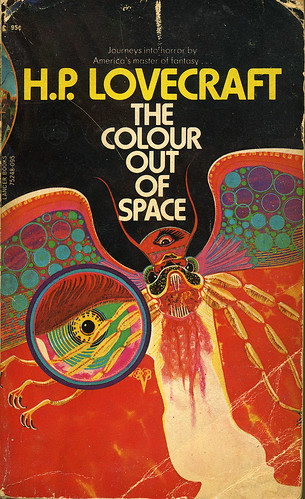
Pulp Fiction Friday: The Colour Out of Space by H.P. Lovecraft

In this week's focus on the great pulp fiction era, I switch gears away from sword and sorcery and into the realm of horror.  Certainly most are familiar with the works of H.P. Lovecraft, primarily his stories of the Cthulhu mythos.  Lovecraft has become a legendary figure among the geek crowd and gaming circles over the past twenty years or so, and with good reason.  His style of writing is reminiscent of the days of classic literature.  His ability to construct a sentence in such a way that it springs the experience of terror right off the page and into the reader's mind makes him a notable contributor to American letters.

"The Colour out of Space" was written and published in Amazing Stories magazine in 1927.  Lovecraft would go on to regard it as one of his favorite stories.  While the story has no mention of Cthulhu, or any of the other entities associated with the mythos, it still possesses all the elements of cosmic terror and alien horror.

The story is told through the perspective of an unnamed surveyor.  He has come to the small New England hamlet just outside the town of Arkham to survey the area for a reservoir development.  While walking through the hills and forests of the area, he gets the sense that the area is haunted.  Eventually he stumbles upon a large spot of gray ashen earth adjacent to the remains of an old house and a well.  Curious about what happened to cause such a thing, he begins questioning the people of Arkham, who speak little about those "strange days."

Eventually our narrator finds a man named Ammi Pierce, the only remaining settler in the area.  Ammi recounts the tale of a fallen meteorite on the farmland that is now called the "blasted heath" and how it affected and slowly destroyed Nahum Gardner and his family.

The story, while a bit slow to develop, builds up to a fantastic and terrorizing conclusion.  What I liked most about this tale was the way Lovecraft handled the monster, if you can call it any such thing.  Rather than describe the alien as humanoid, he continuously asserts how indescribable and incomprehensible the thing actually is.  It is apparently devoid of any actual physical appearance that can be described to the human eye.  Rather, it takes form in the shape of a vast array of colors of which are not in our own earthly spectrum of understanding. 

Lovecraft is a true master of the genre of horror and this tale is easily my favorite of his that I've read.  The full text is available for free, along with a lot of his other works, at manybooks.net.  So, download and dig in for a classic story sure to send chills down your spine and get the wheels of your mind turning.

Saturday, December 25, 2010

Pulp Fiction Friday: The Shadow Kingdom by Robert E. Howard

This is the first installment of a weekly feature here on Black Hole Diaries I call pulp fiction Fridays.  Every Friday I will highlight a story from the pulp age (1920's and 30's Weird Tales and the like) from authors such as Robert E. Howard, H.P. Lovecraft, Clark Ashton Smith, and others of the time period.  In cases where possible, I will provide links to the stories themselves as many of them can be read online for free.  Let us begin.


Before Robert E. Howard brought down the wrath of the mighty Conan and the Hyborian Age onto the pages of Weird Tales, he was busy spinning similar tales centering around Kull the Conqueror.  "The Shadow Kingdom" was first published in the August 1929 issue of Weird Tales magazine.  Although it didn't seem important enough for even a cover blurb at the time, the tale would go on to have a significant impact on fantasy fiction. 

Many people credit "The Shadow Kingdom" with creating what would later become known as the sword and sorcery genre of heroic fantasy fiction.  In the story, Kull, a barbarian from Atlantis, has seized the throne of Valusia through the might of his sword.  One night he is visited by a man from a rival tribe who reveals to him a plot on his life.  As the story unfolds, Kull discovers there is a secret power behind the scenes that has been working in Valusia for years through evil and treachery.  I won't give away any more of the plot for those who may not have read it yet.

Howard's use of words in this story is brilliant as his setup for the action packed climax.  The story, while probably not revealing anything new in the way of storytelling for seasoned readers in the genre, still manages to keep the reader engaged and turning the page until the grand finale.  Of course, most seasoned readers of fantasy literature have likely read "The Shadow Kingdom," but I often find that younger readers of the genre have allowed these foundational stories to escape them somehow.  Classics like "The Shadow Kingdom" are becoming lost along the way in the wake of modern day ground breakers like George R.R. Martin and R.A. Salvatore.  And that is a true shame considering so many of these stories can be found for free online.  In fact, that is where I first read "The Shadow Kingdom" myself.  The full text of this story, as well as many others by Mr. Howard, can be found by visiting ManyBooks.

If you're a fan of fantasy fiction, especially heroic fantasy or sword and sorcery, "The Shadow Kingdom" is an absolute must read.  Head on over to ManyBooks and dig in.  You'll be glad you took the time to read this classic of the genre.