Pages

Showing posts with label ADnD 2e. Show all posts

Tuesday, January 24, 2012

What Motivates Your Players?

Sounds like a simple question really, and one that would seem easy to answer.  What kind of rubbish is this?  Players are motivated by killing things and taking their stuff.  And yes ultimately no matter what kind of game you play in, that is at least one of the end goals, but it is often not enough to motivate your players, especially in a sandbox game.

I often hear the question raised, "how can I get new school players into older style or 'old school' gaming?"  I think the key really boils down to one thing; how experience awards are handled.  This one feature sets the tone for a particular style of play.  You see, back in the day, when players sat down around the table, and began to seek adventure, they did so on their own, and the DM facilitated the world for them.  This was because the players had a goal (kill things and take their shit and advance and become more powerful) and the goal was rooted in the process by which they attained it.  Going up in level via experience points.

The older iterations of the game made it quite clear.  You advanced in level and gained experience points primarily in two ways; killing monsters that were challenging to your level and by collecting treasure.  Even up into the 1e DMG, Gygax held this to be true.  In that guide he references the exchange of treasure, or gold pieces, into a converted ratio for experience and specifically pointed out that the treasure must be somehow carried out of the dungeon, not just found.

The change began in 2e, in which the game began to take a shift overall as a whole.  It became less about gaining treasure and fighting monsters and more about that dreaded two-word-phrase "the story."  In the 2e DMG the notion of awarding XP for treasure is resolved to a small blurb, highlighted in light blue, and annotated as an "optional rule for experience."  

"As an option, the DM can award XP for the cash value of non-magical treasures.  One XP can be given per gold piece, or equivalent, found."

As an option?!  Seriously?  So, the new school player (or those whose roots lie in ONLY 2e or editions that followed) have a clear reference on how the game should be.  This is why the new school player will sit around, waiting for the DM's guiding hand to lead him to "the story."  And when the DM doesn't do this (i.e. the old school DM), the game becomes lost in translation and can become a bit awkward.  An example of how a typical adventure may start with an old school DM with new school players:

DM: Okay, you're at the Blazing Drunk Tavern enjoying drinks with your mates.  A minstrel plays a lively  tune in the common room.  Patrons move to and fro eating and enjoying the evening.  What are you doing?
New school player:  Uhh....I have an ale.
DM: Okay, 1 copper.  The keep brings you the ale.  What else are you doing?
New school player: Uhh....*waits for DM to spoon-feed him "the story."*

A very similar exchange with old school DM and players:

DM: Okay, you're at the Blazing Drunk Tavern enjoying drinks with your mates.  A minstrel plays a lively  tune in the common room.  Patrons move to and fro eating and enjoying the evening.  What are you doing?
Old school player: I order an ale, slap the serving wench on the arse, and ask the keep if there are any rumors of this place.
DM: Okay, 1 copper.  The keep brings you the ale.  The serving wench slaps you in the face.  The keep then tells you of some ruins just outside of town which are said to hold a golden jeweled crown worth a fortune.
Old school player: We head out tonight.

You see, the old school player doesn't need any other motivation than the notion of the possibility of fighting some shit and getting a treasure, because the treasure paves the way for the advancement.  It is THE motivation to play.  There is no need for them to sit around and wait for the DM to serve up the one ring to take to Mount Doom.

The key, when starting a new campaign, is to find  the players who fit the style of game you want to run.  There is nothing wrong with storylines in games.  I use them myself.  But make it clear from the on-set on how experience is gained and how level progression works.  So, if you're running an old school style game, make it clear to the players, "hey, you level up by killing shit and taking treasure because each gold piece worth of treasure taken also equals that much in xp."  If they are new school players, they might not get it at first, because it might not come natural to them.  If you have someone more familiar with this style of play at the table it helps because they can guide the new school player, and really, it's so bloody simple they'll feel foolish for not catching on in the beginning once they see how it's done.  The difference is being able to recognize what motivates the new school player vs the old school player.

To put it in a simple analogy, the new school player is all about the destination (the story) while the old school player is all about the journey.

Friday, January 13, 2012

Planescape: Looking Back

I remember when Planescape came out back in 1994, it kind of changed things in D&D.  In some ways this was good, and in others bad.  I recall being a very narrow-minded teen at the time, and my first introduction to anything "Planescape" came in the form of an acquaintance named Joe.  Joe was a power gamer, in the truest sense of the word.  He was min-maxing before there was such a thing.  My group of friends never were really into that aspect of the game.  We always preferred to play characters from the PHB with actual real stats we rolled, with flaws, and who weren't indestructible superheroes.  We liked to focus more on the roleplaying aspect of the game.  As such, we never were big on munchkins entering our sessions.

Enter Joe.  You see, Joe was playing (what else?) a tiefling.  He had been running this tiefling with a few of his friends in the Planescape setting and wanted to enter our campaign.  I had no idea what a tiefling was, and when he told me it was half-demon from the Planescape setting, I immediately put up a mental block for all things involving the setting.  It had, in my opinion at the time, spawned a layer of such cheese that I refused to take it seriously as a campaign world.  Of course, over the years I think the tiefling has developed in the game into something that truly epitomizes what old schoolers hate about the current iterations of the game, going from optional player characters in later editions, to a core race in 4e.

Now, that is not to knock anyone who enjoys playing tieflings.  Truth be told, Joe could have been playing anything and it would have been irritating (especially considering he was toting around a vorpal blade of all things).  My point here being Joe turned me off of the setting years ago because he was a munchkin, and due to my naivety I presumed that if Joe=munchkin playing tiefling from Planescape then Planescape must=cheesy power gamer setting.  Having the chance to look back at it now and review some of the material I've found for it, I hate that I never gave it a shot, because it rocks...a lot.

Sigil, the City of Doors


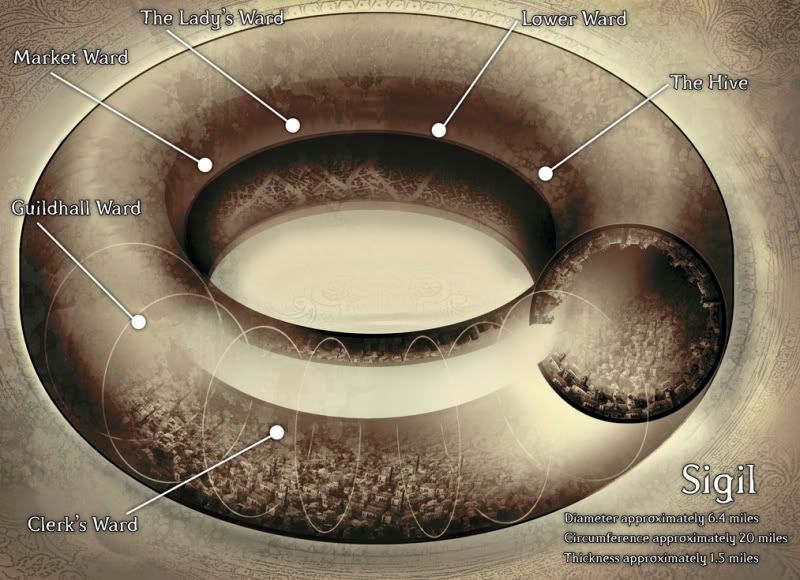
Sigil, the home base for the setting, is a perfect example of introducing "weird" into a game.  Basically the place at the center of the multiverse, with doors to anywhere in the prime material and outer planes, the possibilities within it are potentially endless.  What really strikes me as amazing is the city's layout.  Shaped in the form of a torus like ring, one can literally look up and see the city wrap around with buildings above them.   The city wards themselves change at randomly making it really impossible to fully ever map.  And of course, there are the doors themselves which lead to pretty much any plane of existence one can think of.  Some being hidden, open, locked, etc.  The possibilities for adventure in Sigil alone seem endless.

I'm not sure if I'll ever get to run Carcosa or not, but if it ends up being a "player dump" into that world, I can definitely see them traveling through Sigil.  So, are there any Planescape gamers out there?  Anyone ever used Sigil or any of the other Planescape elements in their campaigns?


Sunday, January 8, 2012

Hexcrawling and Its Fundamental Use in Old School DnD Part 3

Previous entries: Part 1, Part 2.

In the last entry, I discussed creating the first 7 hexes including the starting location (usually a village or city, but could be any civilized area/feature) which is in the center, and at least 3 interesting locations outside of the starting location to explore.

Our starting map with 3 locations to explore

So, this next step requires a little bit of prep time, but don't spend too much time on any of the 3 locations (unless you have the time to do so, that is).  We know we have some sort of tower in hex 04.05, a ruin in 05.03, and a monster lair of some sort in 04.03.  This is the time for some brainstorming.  If you've already taken the time to think of some places/NPCs your PCs are likely to encounter in the starting village (inns, taverns, local lords, sages, etc.) now is the time to start tying them into the surrounding locations.

Why do the NPCs know about the monster lair?  Perhaps it is the home of an ogre who has been pillaging the farms of Windholm at night?  Maybe the spot of a local group of bandits who have been hijacking merchants passing through, effecting the commerce in the village.  Obviously these are quick and simple ideas, but they are presented to give you an example.  Find some way to tie these locations into your starting location.

Jot down some starting notes on each location based on their hex:

04.03 - Lair of Hedgemog the Ogre (stats here in parenthesis)  Has a group of hobgoblins working for him (stats for hobgoblins in parenthesis).  At night Hedgemog wanders countryside (50% chance the PCs might catch him in his lair at night).  During the day he sleeps in his lair and the hobgoblins protect him.

Now, if you have the time, you might want to draw out a quick map of the lair, key it with monsters, traps, etc.  And you'll need to do this for at least the first level of each of the 3 locations, but no more than the first level of each location (if it has multiple levels).  If you're pressed for time, try any number of free dungeon generator tools out there to get a layout for each location quickly, then key it up yourself.

The idea in the sandbox and/or hexcrawl is that the players have freedom of choice to go where they want and basically do what they want (and suffer the consequences therein), so you're going to want to ensure there is incentive for your PCs to want to explore at least one of the areas you've prepared.  There are any number of ways to get your PCs going.  Often most campaigns kick off in the common room of a tavern.  How will the PCs know of these locations or learn of them?  Why should they want to go there?  Perhaps they are approached by an NPC offering payment to retrieve a MacGuffin from one of these locations.  Or perhaps they just hear about one or more of them as prime unexplored locations ripe for plundering via rumors in the town.

Rumors are a great way to get the ball rolling in a sandbox, and in my opinion, offers the PCs the most flexible freedom of choice in what they choose to do.  I would start off with 10-12 rumors with half of them being either completely false or only half-true, while the other half are completely true.  Place them on a chart, and roll for one while they are in the tavern in the first night.  If they actively seek out rumors, roll a die (d4 or d6, subtract reaction adjustment but no less than 0) to determine how many rumors they hear from various occupants of the town.  Roleplaying these out can be great fun as well, and really bring the world alive for the PCs.

The key here is making them WANT to explore places you've prepared.  If you don't make them appealing, chances are your PCs can wander off into areas you haven't really prepped yet, and then you're completely flying by the seat of your pants.  Sometimes this can prove to be just as fun, and to be sure, there will always be a certain level of improvisation that goes into a sandbox or hexcrawl game anyway.

In the next post, I'll discuss topics relating to getting the PCs there (i.e. the actual crawl) from constructing random encounter tables, determining movement, weather, etc.

Tuesday, December 20, 2011

Cormyr Campaign Update or When Actions Have Consequences

So, when you're running a sandbox style game as opposed to a railroad adventure, one of the big things that sets it apart is the fact that your PC's actions will have consequences.  This is all too often forgotten in the sandbox game.  Because unlike a railroad adventure where the PCs will always pop into the room with the evil mage right smack in the middle of sacrificing the virgin, the sandbox is a different animal altogether.  In the sandbox, you have a world, full of NPCs and villains and what all and they all have their own plots, schemes and motivations, and shit is happening in the background.  Sometimes it's major world changing shit, and sometimes it's not so grand, but the point is, when your PCs act, or DON'T act, their should be consequences and those consequences should affect them.
 
If you have been following my Cormyr Campaign series of blog posts, you probably recall that in the first session, the party had an opportunity to find a pretty powerful artifact (although they didn't know it at the time, of course.)  Unfortunately for them, they botched this effort and were sent on a wild goose chase through the Stonelands outside of Tilverton.  In the time it took them to make their way back into the city (after discovering that their original retainer was basically a bad guy) a lot of shit went down. 
 
So, in sum, they made their way through the goblin smuggling tunnels from the Stonelands back to the sewers of Tilverton.  Cleverly disguised as bandits with a passphrase to get into the thieves guild controlled sewer system which they retained from a bandit encounter, they were ready to get back into the fray and find this thing before it fell into the wrong hands.  They were too late.  Instead of tracking down this thing (which they learned a little about while in the Stonelands), they were greeted by undead...who were multiplying rapidly.
 
After an encounter with a Purple Dragon patrol in the sewers, they discovered several things had happened in their absence.  First, all of the priests from the friendly temples in Tilverton had been murdered almost simultaneously.  The undead had begun ravaging the sewers and some were making their way to the city streets as well.  The Purple Dragons had uncovered that the ancient crypts, sealed up long ago, had been breached from the inside.  Something blew the seal open, and it was believed the source of this chaos, whatever it was, was stemming from somewhere within the crypt.
 
So, this now leaderless Purple Dragon patrol (their sergeant killed earlier by said undead) were commanded by one of the PC's (a hedge knight in Cormyr) to accompany the party into these crypts to investigate.  Along the way, the party discovered a secret temple devoted to Myrkul within the crypts with lots of evil necromancer types, a few undead, and a group of stone guardian golems (which almost resulted in a TPK.)  As the session ended, they were spending time resting and recouping in the crypts attempting to gain some strength (and lost hit points) before pressing forward.  Their resources nearly depleted (most spells cast, hit points low, etc.), they now face the dilemma of spending valuable time restoring resources or pressing forward.  They choose to restore their resources.  Again, this action has consequences.  One they'll discover in the next session in the form of a 7 hit dice abomination summoned from the Abyss.  
 
Shit has hit the fan in Tilverton, and the more the PCs delay, the closer they come to losing the city.  Because their actions have consequences. 

Friday, August 19, 2011

On Building a Better GM

I happened to notice several other bloggers taking up ckutalik's challenge on building a better GM, which was inspired by a post by one of my favorite bloggers, Beedo.

Ckutalik asks us to elaborate on 3 essential elements as follows:

1. Name three “best practices” you possess as a GM. What techniques do you think you excel at?
2. What makes those techniques work? Why do they “pop”?
3. How do you do it? What are the tricks you use? What replicable, nuts-and-bolts tips can you share?


It's hard to narrow it down to just 3 "best practices" really. In surveying my own thoughts on the issue, dozens of best practices come to mind, however I'll try to stick to what I believe are the 3 most important.

1. The game is not about you, it's about your players

It's a hard truth to accept for many GMs. We all have our own philosophies on how the game should be played, but ultimately, the only ones you really need to worry about impressing are your players. That is not to say that you fudge dice rolls, or give into unreasonable player demands at the table. Rather it means keeping your focus on what the players want to do in the game as opposed to what you would like to see them do.

This especially rings true in preparation. There have been countless times when a GM has sat down with his players, having prepared a nice little adventure for them, only to have them do something completely off the wall which derails all that preparation. We hear about these things happening at the table all the time, and true enough, they happen at my own. It's part of the game. You have to learn to roll with it, because it's never going to change as long as you believe in not restricting player control over their characters.

This is where the sandbox style really shines, however, because you are providing a world with which the players interact, and the choices they make should always matter. Resist the urge to railroad players into certain situations. Present the adventure hooks for them, and let them take it in the direction they choose. This is going to require improvisation on your part as a GM, but if you're remotely considering sandbox style play, you must accept the fact that you will likely be improvising...a lot.

Make the world around your players a living and breathing thing. There are NPC motivations outside of what your players are involved in at a given time. Their characters can't be everywhere all the time. Maybe they have a few options in the beginning, but they won't know the results of their actions until things are played out. For example, they have option 1, which is to raid a nearby set of ruins overrun with undead, or option 2, which after some investigation by the players, results in their foil of an assassination attempt. If they pick option 1, don't forget about option 2, and let the consequences of their choices take place. Let that major NPC get assassinated because the players didn't take that hook.

Know your world, and write down notes on events surrounding it. These don't have to be detailed pages and tomes of useless information that may never come up in play. Just a series of simple bullet style notes, preferably keeping it in line with your campaign world calendar. Those particular events in which your players actively chose not to participate in, should happen. The ones in which your players took the bait of a hook should be saved and the results determined by their actions in the game. Doing this, they will quickly realize that their actions have consequences, and will respond accordingly.

Ultimately you want your players to have fun, and have a strong desire to return to the gaming table and continue. That's what it's all about. If your players prefer detailed railroady storyline games over an open-ended sandbox style, then give them what they want, or find a group of players whose play style fits more in line with your own. Don't force players down a path they don't want to take in play style, because the results will often be complacency at best, or downright apathy at worst.

2. Stay Organized

I am the most unorganized person you'll ever meet really. My organization skills in general entail trying to remember if I laid that notebook under the bag of Doritos I've been working over, or with a bunch of other notebooks piled on top of my printer. Still yet, I try my best to keep things organized when it comes to the RPGs I run.

I can't stress enough how important it is to have a campaign notebook. For me, this typically means a traditional 3 ring binder with dividers, document protectors, and various useful in-game documents. That said, your campaign notebook can entail a number of different options. Find whatever is best for you, and run with it. If you can keep things organized on a laptop, or on a site like Obsidian Portal, use those methods, but try your best to stay organized.

So, how do I do it? As I said, I have a 3 ring binder I use, tabbed with document protectors. I have a section for maps, random tables and charts specific to the area the players are in, and a section of notes for the game.

I have stated above how important improvisation is in sandbox gameplay. I tend to use a lot of tables and charts which I can quickly refer to in a jam. These include NPC name generator tables, inn and tavern name tables, random trap and trick generators, etc. These are particularly handy because they allow you to focus your creative energies into important stuff, like the game, rather than having to spend mental energy to find a clever name off the top of your head for a NPC or location, which may end up sounding stupid (we've all been guilty.)

In my maps section, I usually keep a handful of maps I have either made, or found online. There's usually a mixture of both. Some of these mini-dungeon areas are keyed, while others aren't, but the idea is to whip one out in a jam when the PCs go off the beaten path. This way I'm not completely caught off guard. I know, for example, in general where my players are on my hex map before each session. I will then prepare a few maps and encounters for various locales in and around those hexes. Nothing too fancy, just enough to give me something should they wander off from what I perceive to be their goal at the time. Best of all, I can always use those maps in other areas later if need be.

The notes section is probably the most important section of the notebook. I have a campaign log which I keep, an item spreadsheet which lists who has what item, where they got it, if it's been identified and the items known and unknown properties. I also keep a small chart to document xp to help me calculate everything at the end of a session.

My campaign notebook is like my GM bible for the game. A good, well kept campaign notebook, will bail you out of sticky situations, and just make life easier for you as a GM, which in turn, will make things better and more enjoyable for the players.

3. Don't over-prepare

Don't spend too much time in preparation, and stick to things that will directly involve your PCs. Do you really need to write up 3 or 4 paragraphs of notes on a temple or inn your players may never visit? Improvise many of these things. Stick to what's important for the upcoming sessions. Yes, this can be, more or less, a fly by the seat of your pants method, but that's the fun of the sandbox. You're discovering your world along with the players.

When I start a new campaign, I like to take a hex map, key out several locations of interest, without detailing them too much, a brief set of notes on major NPCs in the area, and their motivations, various secret groups and organizations, a very brief overview of the political climate of the area, etc. These don't have to entail hours upon hours of needless preparation. Just a few notes, allowing you to focus on really preparing the important stuff, like areas your players might explore. Throwing up a few one page dungeons to get things going is a good idea.

It's very easy to find yourself spending hours preparing for scenarios your players may never encounter. I've done it myself, and in many ways, it's simply unavoidable, but try to limit the time and energy you spend on your campaign into what directly involves your players in the current session. Trust me, some of the best moments at your table will come through improvisation and just winging it. Just ensure you take good notes (or keep a campaign log as I mentioned in point 2), so you can keep things organized.

Some of these methods may work for you, some may not, and many of you are probably already implementing these methods in some form in your own games anyway. There simply is no absolute best way to GM. It would be a pretty boring world if that were the case. Still yet, we all have techniques and experiences to draw upon, which can make the job of GMing easier if we actually take the time to read and learn from others.

Tuesday, August 9, 2011

Cormyr Campaign: Session 2

Cast of Characters:
 
Sir Bryndan Lowman of White Forks - Human, Fighter, 1st level.  A hedge knight from the nation of Cormyr.  His family squandered away all of his lands and holdings so all he has left is his title.
Kylar - Elf, Ranger, 1st level
Clangar - Dwarf, Fighter/Cleric, 1st level
Sylana - Human, female, Bard, 1st level
Cory - Elf, Cleric/Mage, 1st level
 
This session picked up right where the first left off.  The party just managed to dispatch a group of goblins in the stonelands who attempted to ambush them on a small trail.  It was late afternoon on Mirtul 8th, and the party decided to set camp there at the ambush point.  Myst and Maverick decided to head back to Tilverton to do some information gathering (there players were not present due to real life stuff.)  At this point, the party consisted of Sir Bryndan, Kylar, Clangar, and Sylana.
 
During the night, Clangar was on watch and heard the sound of a screaming girl off in the distance.  He woke the party up, and Kylar set out to investigate while the others prepared their gear.  About 200 yards away from the camp, Kylar caught glimpse of 4 human bandits on horseback pursuing a girl in tattered rags.  He engaged the riders and within a few rounds was soon met with the rest of the party.  The non-humans used the pitch black darkness to their advantage against the human bandits taking them out from a distance, while Sylana moved up to aid the girl.  After dispatching the riders, the girl revealed that she had been a slave taken captive by the Red Hand bandits, but had managed to escape.  The bandits managed to track her down finally and were about to capture her to return her to their camp when the party came along.  She mentioned that there were several other slaves at the bandit camp including her 8 year old brother.  After some questioning, specifically if she knew of the tunnel location into the Tilverton sewer network from the Stonelands, they agreed to aid her.
 
Kylar set out that night to locate and scout the bandit camp while the rest of the party remained behind to question one of the bandits they'd taken captive during the encounter.  Kylar found the camp, which sat in a circular depression about 10 feet deep.  After taking out a couple of the camp guards, and nearly losing his life in the process, the bandits were alerted to his presence.  Kylar used his infravision as a tactic against the human's inability to see in the dark, jumping from boulder to boulder hiding (these large mishapen boulders are scattered throughout the Stonelands) and attempting to make a tactical retreat.  Eventually he heard the party coming behind him and pointed them in the direction of the camp.
 
Bryndan charged in with his horse, while Kylar moved back to the lip of the depression.  He was able to identify one of the bandits who seemed to be ordering the others around during the chaos.  He took a shot at the leader from his vantage point, taking him out with a massive arrow strike.  The bandits were thrown into chaos.  Sylana moved along the edge of the camp, with the slave girl in tow.  Clangar moved into the camp on foot behind Bryndan.  
 
As the party moved in to attack, the noticed a large ogre cresting the far side of the depression.  He charged in on Bryndan and Clangar came to aid.  The two fought the ogre for most of the battle, while the bandits surrounded them attacking as well.  Kylar dispatched several bandits and identified a mage within the camp standing behind a tent.  He moved along the outer edge of the depression until he got line of sight with the mage, who was unaware of his presence.  Finally the mage saw Kylar coming along, and cast a grease spell in the area.  Oddly enough the ogre disappeared in thin air.  Kylar took a shot and managed to kill the mage.  Sylana moved in behind near the mage and was attacked by a bandit, who dispatched her.  After the battle she was revived by Clangar.
 
The remaining bandits were easily taken out, while Clangar decided to keep one alive for questioning.  After defeating the bandits, the party released the captives and the slave girl was reunited with her brother.  Among the captives was an elf who identified himself as Cory.  The party measured him up figuring him to be a magic user of some sort, and after a bit, asked if he'd be willing to join them to which he agreed.  The party spent the rest of the night looting the bandits and seeing that the slaves were given food and comfort. 
 
Clangar searched the bandit leader's tent and discovered the journal of a now deceased cleric of Lathander from Tilverton.  In the last journal entry, the cleric had fallen victim to a mortal wound from a gnoll's spear.  In the entry he identified that he and his adventuring party had been in the Stonelands on a mission of great urgency.  They were seeking out a horn, being carried under the guise of a merchant caravan with the standard of a red sun emblazoned on the side of the crates.  The cleric mentioned that the horn was bound for Tilverton to be delivered to a death cult devoted to the dead god, Myrkul.  The horn would give the cult the power to raise the dead, which the cult intended to use to raze the city.
 
The party put things together realizing that the man who hired them was the merchant in question, which explained his urgent desire to retrieve his wares (since they contained this horn.)  The party knew from the previous session, that the last known location of the crate was Tilverton, and in fact were searching for a way into the sewers from the Stonelands to intercept it on its way out.  They questioned one of the bandits and decided it best to take him with them at first light, as he knew the location of the sewer tunnel entrance from the Stonelands.  He warned them they'd need gold to get in because "Lady Alundra controlled the entry point."
 
The next morning at first light, the party prepared a cart for the now freed slaves, and gave them supplies including the bandit weapons.  Bryndan instructed them to head for Griffon's Hill where they could gain aid from a knight he knew there.  The party set off from the camp, with the captured bandit in tow, on horseback headed to the tunnel.  After a few hours of travel, they found the tunnel entrance.  Upon entering they noticed a large chamber with two life-sized stone statues, one of a paladin in full livery with his sword coming down to strike, and the other depicting a mage in the midst of casting a spell of some sort.  They approached carefully, and entered a more narrow tunnel where they saw a closed portculis sealing the tunnel, and a door in the wall to the tunnel.  They knocked on the door and were greeted by a blind man.  After some rather poor haggling, the blind man agreed to let them pass in exchange for 200 gold pieces.  Clangar advocated smashing the man's head in and prying the portcilus loose, but the party managed to calm him.  They paid the blind man the coin, and he raised the portculis to allow the party to pass.
 
Thus the session ended.
 
 
Reflections on the Second Session:
 
One of my players decided to make a new character entirely.  His other character had been captured by the Rogues of Tilverton in the first session, and although we managed to play out his escape, we thought it best to start him with another character.  There were several reasons for this, not the least of which being mounting frustration at the table from the other players with this particular player's style, which is to often split from the party and do his own thing.  In an effort to keep everyone's minds on the game and adventure itself, I thought it best if he just create a new character.  So Solaris has gone on to be NPC material while Cory the elven cleric/mage enters the picture.  After having to sit out most of the first session and most of this one even, due to being captured, I think the player got the message that his actions can have consequences as a player, and he might not get to enjoy the fun by splitting off on his own.
 
I introduced the players to the d30 rule, that being once per session they can opt to roll the d30 for any game activity not counting character creation/leveling.  Kylar's player cleverly looked for the bandit camp leader, and hit him with an arrow, to which he picked up the d30 to roll for damage, knocking him for 24 points.  That's 3 times as much as a normal arrow will produce.  It was quite epic.  The mage used an Improved Phantasmal Force to produce an ogre to distract the party while the bandits attacked.  None of the party members managed to realize this, even after Clangar rolled a d30 for damage against the ogre, which would have effectively killed the real thing, they never thought to disbelieve the illusion.  The mage spent most of the battle behind cover to maintain concentration on the illusion.
 
Overall, I thought the session went very well.  The players were engaged throughout, and anxious to keep playing.  They never broke their focus on the game at all, which was quite surprising for this group.  There were some close calls, but I was particularly impressed with the way they handled the bandit camp.  Kylar's player did exceptionally well, and was rewarded as such with some additional xp.  Now, the party is entering the long winding tunnel system leading into the sewers of Tilverton, and who knows what nasties they'll find in there...but they'll know soon enough.